Blog post: Online security
Hello and welcome to Scam Or Reliable!

Blog post: Online security
 Consumer credit fraud through identity theft often happens without any direct interaction with the scammer.
The victim does not necessarily click on a fake payment, approve a transfer or knowingly sign any contract. Their administrative identity is used remotely to open credit that they may only discover several months later.
This mechanism makes the scam particularly distressing, because it turns ordinary documents into the starting point of a fictitious debt.
Online consumer credit can be requested with supporting documents submitted digitally. This simplification benefits legitimate borrowers, but it also attracts fraudsters looking for complete ready-to-use files. An identity document, payslip, tax document and proof of address can sometimes be enough to create an appearance of seriousness with an online credit provider.
The victim often has no immediate sign. Their documents may have been sent weeks earlier for a rental application, a job application or an ordinary administrative procedure. As long as the first repayments are made or the credit provider has not yet started recovery, the identity theft can remain invisible.
This lack of apparent fault adds a heavy psychological dimension. Many victims first look for what they may have done wrong, whereas the core of the problem lies in the fraudulent reuse of documents already provided or stored. The right reflex is therefore to protect these documents before sending them, then react methodically at the first suspicious letter or message.
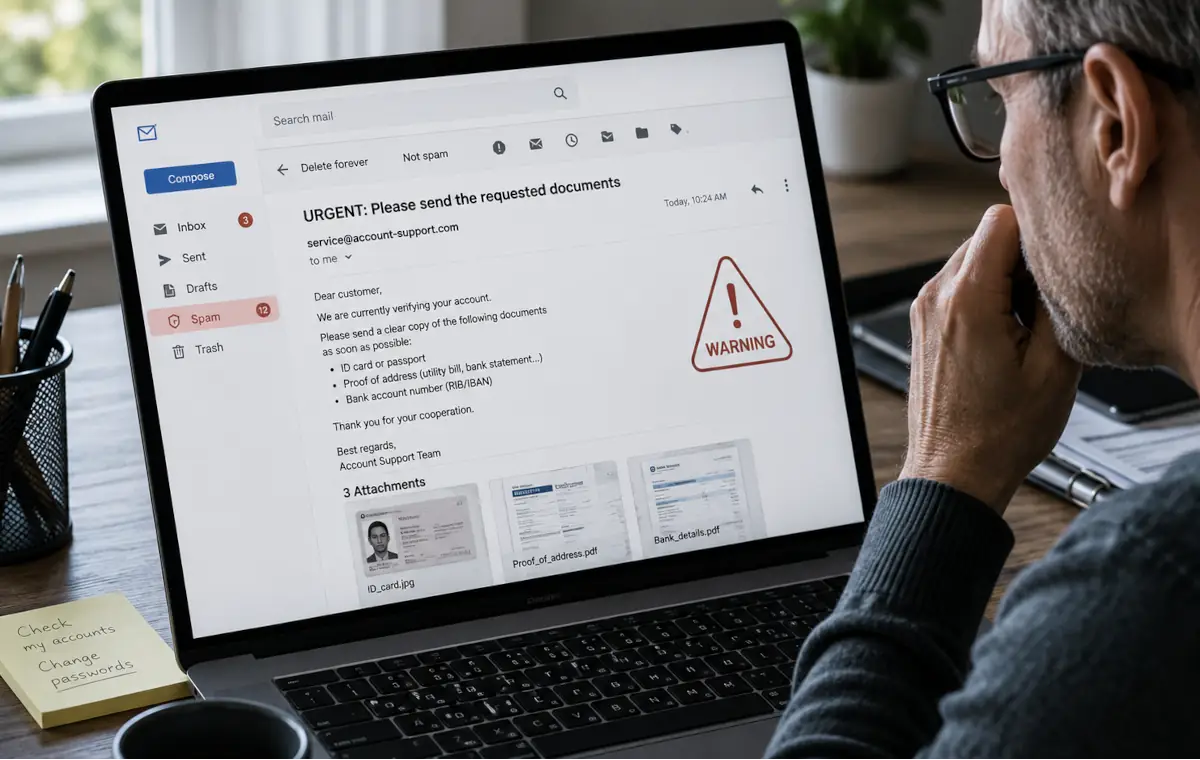 Fraudsters look for complete files, because an isolated document is less valuable than a coherent set. An identity document accompanied by a payslip, tax document and proof of address makes it possible to fill in many fields during a finance application. The most effective collection channels are often those that seem ordinary when the victim sends the files.
The email inbox remains a prime target. Many people keep copies of documents sent or received in Gmail, Outlook, Yahoo or other services. A hacker who gains access to the account can search for keywords such as identity card, passport, payslip or wage slip, then quickly download the useful documents.
Fake adverts are another frequent scenario. A supposed rental listing or job offer published on a popular website can be used as bait to request a complete file. The request may seem coherent, because viewing a flat or validating an application often involves providing personal information.
 Once the file has been obtained, the scammer has a credible basis for presenting themselves as the borrower. They go to an online consumer credit application platform and enter the victim’s information. Fast automated procedures can then be exploited if the checks fail to detect the inconsistency between the declared identity and the real beneficiary of the funds.
The bank account entered in the application is not always the victim’s. The scammer may provide their own account, sometimes opened with an online bank or fintech using another false identity, in order to receive the money. As soon as the transfer arrives, the account is emptied, which then makes recovery of the sums more difficult.
The credit may be presented as a personal loan or as financing for a fictitious purchase, for example a vehicle that does not exist in the real transaction. From the victim’s point of view, nothing happens yet, because no debit appears on their personal account. The trap closes later, when the repayments are no longer made and the organisation seeks to recover the debt.
The first warning sign often arrives by post or email, in the form of an unknown reminder. A formal notice, a message from a debt collection agency or correspondence linked to credit you never took out should not be ignored. Even if the letter seems absurd, it may indicate that a file has been opened with your information.
Another clue concerns sudden refusals during a real financial project. A legitimate credit application may run into an entry on a credit file or fraud prevention database, even though the person knows nothing about any missed payment. In the UK, you can check your credit files with the main credit reference agencies, such as Experian, Equifax and TransUnion, and check whether a Cifas marker may be involved. In the US, you can check your credit reports through the authorised annual credit report system and consider fraud alerts or credit freezes with the main credit bureaus.
The appearance of letters from enforcement officers, debt collectors or collection agencies often comes as a shock. The right attitude is not to pay simply to calm the situation without understanding it, but to request precise details about the disputed credit. The sooner the victim gathers the documents, the more effectively they can structure their dispute.
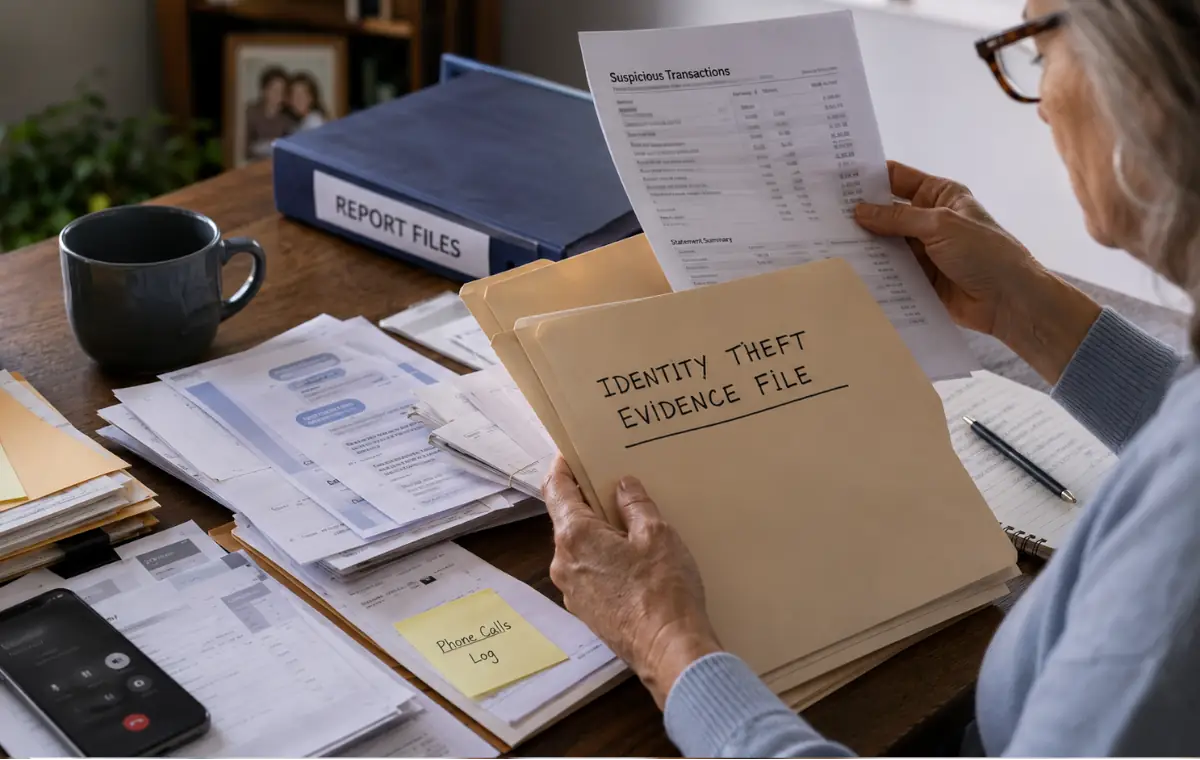 The first step is to keep all the elements received. Letters, envelopes, emails, file references, names of organisations and contact dates should be grouped together. This timeline will help explain that the disputed credit was opened without your consent.
You should then ask the credit provider for the information linked to the file. The goal is to understand which documents were used, which bank account received the funds and on what date the application was validated. A full response is not always immediate, but the request helps formalise the dispute.
Checking the relevant files also helps measure the extent of the problem. In the UK, check your credit files with the main credit reference agencies and look for any fraud-related markers or unfamiliar accounts. In the US, review your credit reports, dispute fraudulent accounts and consider placing a fraud alert or credit freeze if identity theft is suspected.
A blank copy of an identity document or payslip can be reused outside its initial context. A watermark reduces this risk by clearly marking the purpose of the document across its surface. The text should be precise, for example stating that the document is provided exclusively for a specific rental application, with a date.
A watermarking tool or document editor can be used to add this transparent marking. It can be used for an identity document, driving licence, payslip or another supporting document that has to be sent. A document marked in this way becomes much less usable for a credit application, because the stated purpose does not match the fraudulent subscription.
This reflex must happen before sending, not afterwards. Once a blank file has been sent to a stranger or stored in a compromised mailbox, it may circulate without your knowledge. Watermarking does not replace caution about the recipient, but it adds a useful barrier against reuse.
A personal mailbox often concentrates years of sensitive documents. Attachments remain in sent, received, archived or sometimes deleted messages. For a hacker, this accumulation represents a direct source of exploitable identity material.
Regular cleaning limits the damage if the account is compromised. After a completed procedure, delete copies of identity documents, payslips, proof of address and tax documents that no longer need to be kept in the mailbox. Also remember sent messages, which are often forgotten even though they contain the same attachments.
Two-factor authentication greatly strengthens access to the main mailbox. Validation by SMS or through an app such as Google Authenticator prevents access with the password alone. Even if a password has been discovered, the hacker then faces an additional step.
Consumer credit fraud through identity theft relies on a simple idea: turning authentic supporting documents into a fraudulent borrowing file. The best protection is never to let blank copies circulate, to watermark sensitive documents and to secure the mailbox where these files may have been stored. If a debt collection letter or unexpected file entry appears, gather the evidence, check the relevant credit files and dispute it without delay.
To explore useful reflexes further, read our guide on the habits to adopt to limit scams. If you are already affected, our support path for victims can help you organise the first steps, and the tool dedicated to structured fraud reporting helps prepare the important information before acting.