Blog post: Online security
Hello and welcome to Scam Or Reliable!

Blog post: Online security
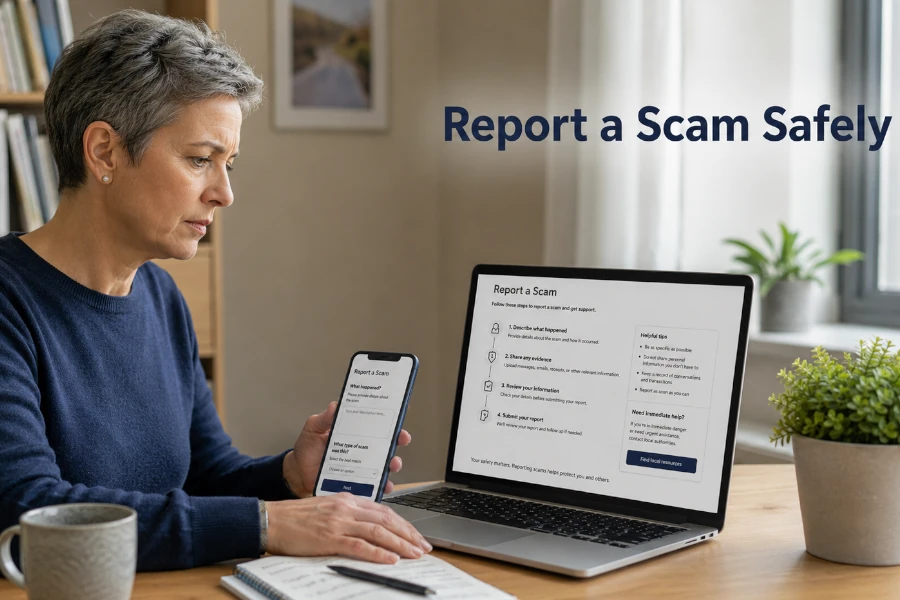
Reporting fraud is a useful reflex, but this moment can also expose victims to a second trap. Fake support, money recovery or complaint-filing services exploit confusion to obtain fees, documents or sensitive information. To avoid this double penalty, you need to distinguish official channels, useful platforms and dubious intermediaries. A simple approach allows you to report without rushing towards the first result found online.
After fraud, the victim often looks for a quick answer. They want to recover their money, block the scammer, file a complaint, have an advert removed or understand which step to take. This urgency creates fertile ground for fake support services.
Fraudsters know that affected people are more vulnerable in the hours or days following the scam. They can create sites that imitate official services, buy advertising placements or publish fake reassuring testimonials. Their goal is to make people believe they have privileged access to a refund or reporting procedure.
You must therefore remain cautious even when the site seems helpful. A serious support service does not promise to recover the money for certain, does not demand immediate fees under pressure and does not unnecessarily require sensitive documents. The first rule is to check who you are dealing with before sending anything.
The word “report” covers several different actions. Reporting phishing, reporting a fake online shop, disputing a payment, filing a police report, alerting a platform or asking for technical help do not always involve the same channel. Confusion at this stage can lead you to an unsuitable service.
Before looking for a form, identify the main problem. Have you lost money? Have you shared your banking details? Have you received a suspicious SMS? Have you spotted a fake website? Are you dealing with a dispute involving a real company? The answer points to different contacts.
This step avoids mixing everything together. A bank handles payment disputes, a platform can remove content, a public service can collect a report, and law enforcement may intervene depending on the seriousness of the facts. No single website solves every situation in a few minutes.
To access an official service, avoid links received by message, comments on social media and adverts promising immediate help. The safest option is to type the known address yourself, go through a recognised institutional website or use a bookmark already saved. This precaution limits the risk of landing on a fraudulent copy.
The right reporting channel always depends on the situation: fake website, suspicious email, fraudulent SMS, identity theft, financial scam, social media scam or another attempted fraud. To help you find the right direction, you can use our fraud reporting assistant, designed to identify the most suitable steps according to the type of problem encountered.
The goal is not to automatically answer every case, but to help you avoid bad reflexes and prioritise reliable, identifiable access points that are consistent with your situation. Always beware of pages that promise immediate recovery, miraculous help or guaranteed resolution.
A fake support service often tries to appear official. It may use administrative wording, reassuring visuals, a detailed form or expressions such as “approved service”, “priority case” or “recovery unit”. This appearance is not enough to prove its reliability.
The most worrying signal remains the promise of a result. Guaranteed money recovery, an accelerated police report or an assured refund are suspicious formulations. Even legitimate services cannot guarantee the outcome of fraud, especially when funds have already been transferred.
Money recovery services are one of the most common traps after a scam. Some operators claim they can trace lost funds, block a crypto wallet, cancel a transfer or launch a fast international procedure. In most cases, these promises must be examined with great caution.
A victim may be tempted to pay because they want to repair the initial loss quickly. This is precisely what scammers exploit. They sometimes request administration fees, legal fees, fictitious taxes or an advance supposedly needed to release the refund.
Before paying a private service, check its identity, legal notices, address, terms, independent reviews and the reality of the service provided. Never share your banking access, verification codes or passwords. A serious professional will not ask you to bypass official procedures.
An effective report requires precise elements. You need to keep the messages, links, email addresses, phone numbers, screenshots, payment references and exchanges. This information can help understand the method used and support your action.
But keeping evidence does not mean sending it to just anyone. An identity document, bank statement or screenshot containing sensitive data should only be sent to a legitimate contact when it is genuinely necessary. Before sending a document, ask yourself why it is being requested and what it will be used for.
It is often preferable to start with non-sensitive elements: date, type of scam, channel used, possible amount, suspicious link, displayed name and payment method. More sensitive documents should only be involved if the channel is confirmed and the request is consistent.
If you have shared your banking details, approved a transaction or noticed a fraudulent debit, reporting does not replace contacting your bank. In this case, the priority action is to block the payment method, dispute the transaction or secure the account. Reporting comes afterwards.
This distinction is important. Filling in an official form can be useful, but it does not necessarily stop a transaction in progress. For a bank card or a transfer, the immediate contact remains your bank or the payment service concerned.
Never use a number provided by the scammer to contact your bank. Go through the official app, the official website or the number printed on the back of your card. Fake bank advisers often exploit victims who think they are solving the problem.

After fraud, many people search “how to recover my money” or “report a scam” in a search engine. Results can mix official bodies, information articles, private services and dubious pages. Sponsored ads are not automatically fraudulent, but they should not be considered official by default.
A fake service may appear with a reassuring title and a very direct promise. It may also reuse words such as police report, refund, victim, fraud or assistance. Appearing at the top of a search page does not guarantee reliability.
Take the time to check the website address, publisher, possible fees and service limits. If the site mainly highlights a promise of fast recovery, it is better to look for an official or independent source before going further.
Reporting fraud is useful, but the process must be done methodically. The right reflex is to identify your need, choose a recognised channel, keep the evidence and avoid services that promise a guaranteed solution. After a scam, rushing can open the door to a second fraud.
To find the right direction according to your situation, use our tool for choosing the right reporting channel. If you have just been targeted and do not know where to start, also consult our support path for reacting after a scam. To strengthen your reflexes, our guide on essential precautions against scams can help you avoid the most common traps.