Blog post: Online security
Hello and welcome to Scam Or Reliable!

Blog post: Online security
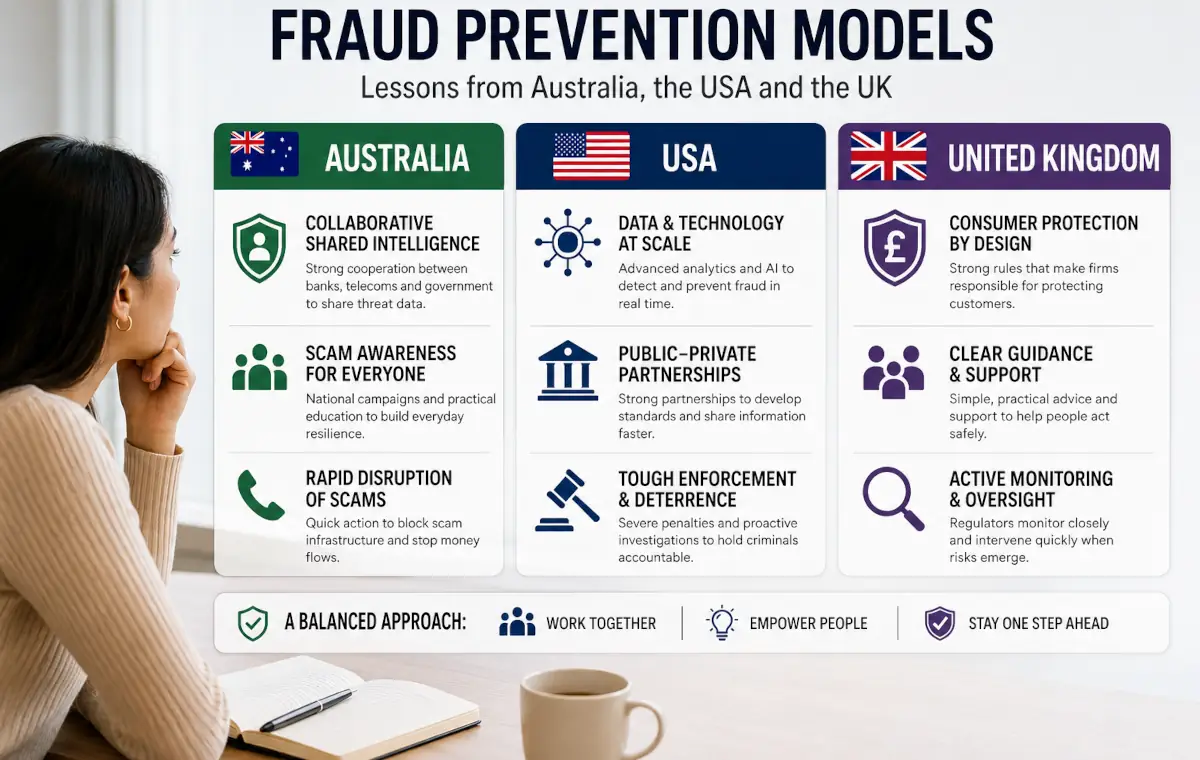
Financial and digital fraud is no longer limited to an easy-to-spot fake email. It exploits instant payments, emotional urgency, already exposed personal data and the trust we place in brands, banks or people close to us. Comparing the Australian, American and British approaches helps identify useful principles, without pretending that a foreign model can be directly transposed. The issue is simple: prevent better, detect earlier and react more effectively when doubt appears.
Fraud prevention rarely relies on a single measure. A warning message can be useful, but it becomes more effective when it is accompanied by bank verification, simple reporting and a quick response from the actors concerned. This is precisely what observing different models can offer: not a single recipe, but a more complete reading framework.
Australia, the United States and the United Kingdom are often cited in discussions about fighting scams, because they illustrate three complementary dimensions. The first angle emphasises coordination between sectors, the second focuses on consumer information and traceability, and the third on accountability around payments. These approaches do not replace existing national rules, but they help identify weak points in a prevention system.
For a consumer, this comparison is a reminder that you should not wait until you are a victim before getting organised. For a bank, it highlights the importance of early detection and education at the critical moment. For public authorities, it shows that fraud must be approached as a cross-cutting phenomenon: financial, digital, social and psychological at the same time.

The approach associated with the Australian model is interesting when viewed through the lens of coordination. Modern fraud often goes through several stages: contact through messaging, a fake website, identity impersonation, then a payment or the transmission of data. If each actor only sees one fragment of the scenario, the alert often arrives too late.
The first lesson is therefore to improve the circulation of weak signals. A number used to approach victims, a suspicious payment page, an imitated company name or an identical message sent to many customers can become useful indicators. The difficulty is not only technical: the information must also be understandable, usable and transmitted at the right time.
This logic directly benefits consumers. When a bank, operator, platform or public service detects a recurring pattern, the user should be warned before the irreversible action, not only after the loss. This requires simple messages, without jargon, that explain the concrete risk and the action to take.
The American approach is often mentioned for its emphasis on public information and documenting the facts. In a scam, the victim may feel isolated, confused or ashamed, which delays the response. Yet the sooner the facts are described, the more possible it becomes to identify a scenario, preserve evidence and prevent other people from being exposed to the same method.
This logic highlights an essential point: unreported fraud remains largely invisible. Even when money has not been lost, an attempt may contain useful information. The address of a fake website, the text of a text message, the name used in a call or a screenshot of an advert can help identify a fraudulent campaign.
Consumer information should not, however, be limited to general slogans. Saying “be vigilant” is insufficient if people are not told how to check, what to keep and who to speak to. Effective prevention turns abstract advice into concrete actions that are easy to apply under pressure.

The British model is often cited when payments and shared responsibility are discussed. The central idea is not to block all payments, but to add useful friction when the risk increases. In practice, a few seconds of verification can prevent a decision made under pressure.
Fraudsters often try to speed up action. They mention urgency, a limited opportunity, an account to secure, a relative in difficulty or a blocked delivery. Faced with this pressure, a well-designed checking step can interrupt the automatic reflex and put the user back into a verification mindset.
This friction must not become a permanent nuisance. It is useful when it is targeted, clear and proportionate to the perceived risk. An effective warning must say why the transaction deserves attention, which fraud scenario is possible and which simple action makes verification possible.
Prevention starts with a simple personal method. It is not about becoming a cybersecurity expert, but about putting in place reflexes that withstand fraudsters’ staged scenarios. Foreign models all remind us of one obvious fact: the best alert is the one that occurs before financial commitment or the transmission of sensitive information.
The first reflex is to separate the message received from the action requested. An email may seem official, a call may sound convincing, an advert may copy the codes of a known brand, but that does not prove the request is legitimate. Verification must therefore be done through an independent path.
The second reflex is to slow down. Most scams work better when the victim acts quickly, alone and under pressure. A delay of a few minutes, a call to someone close or a link check can be enough to reveal an inconsistency.
A bank sees signals that the customer cannot always interpret alone. A change in behaviour, an unusual beneficiary or a series of atypical transactions can justify an educational alert. The aim is not to replace the customer’s decision, but to help them understand the risk at the moment when they can still act.
The quality of the message is decisive. An alert that is too vague will be ignored, while a warning that is too technical may not be understood. The right balance is to name the possible scenario: fake adviser, identity impersonation, dubious investment, urgent purchase or a request from a supposedly distressed relative.
Banks can also improve the aftermath. When a customer thinks they have been trapped, they need to know what information to provide, which payment methods to secure and which exchanges to keep. A clear response reduces panic and increases the chances of limiting the consequences.

From the point of view of public authorities, the international comparison highlights one priority: making the prevention and reporting journey understandable. A victim should not have to guess whether their problem concerns bank fraud, an online scam, identity theft or a consumer dispute. The system must guide them using simple words.
Prevention must also be continuous. A one-off campaign can raise awareness, but fraudsters adapt their scenarios. Messages must therefore evolve with observed practices: fake technical support, fake deliveries, dubious investments, romance fraud, administrative phishing or impersonation of an adviser.
In the United Kingdom and the United States, official organisations and platforms can be useful depending on the situation, such as the National Cyber Security Centre (UK) for digital risks, Report Fraud / Action Fraud (UK) for fraud and cybercrime reports, ReportFraud.gov and the Federal Trade Commission (US) for fraud and consumer problems, or the FBI Internet Crime Complaint Center (US) for certain online crimes. The important point is not to multiply entry points without explanation. Clear guidance helps victims act faster and avoids giving up.
Comparing three models does not mean that one would be superior to the others in all circumstances. Each country has its own rules, banking practices, payment habits and reporting channels. A measure that is effective in one context may be less relevant elsewhere if it is not adapted to local behaviours.
A common illusion must also be avoided: believing that a technical system will be enough to eliminate fraud. Scammers exploit trust, fear, loneliness, the hope of gain or a sense of urgency. The response must therefore combine technology, education, human support and shared responsibility.
Finally, prevention must not turn into blaming. A person who is trapped is not necessarily careless; they may have been confronted with a very carefully crafted scenario, at the right moment, with credible information. A mature anti-fraud system protects better when it helps people understand, rather than judging them afterwards.
The Australian, American and British models show three complementary paths: better coordinating alerts, making attempts visible and adding useful checks at the decisive moment. For consumers, this translates into simple reflexes: slow down, verify through an independent channel, keep the evidence and report without delay. To explore these reflexes further, you can read our guide to understanding and reacting to fraud, test a situation with the anti-fraud vigilance simulator or analyse a dubious link with the suspicious URL checker.