Posted by René Ronse
Alert : Identity Verification Scam – Fake Checks to Steal Your Official Documents
Updated on 18 September 2026.
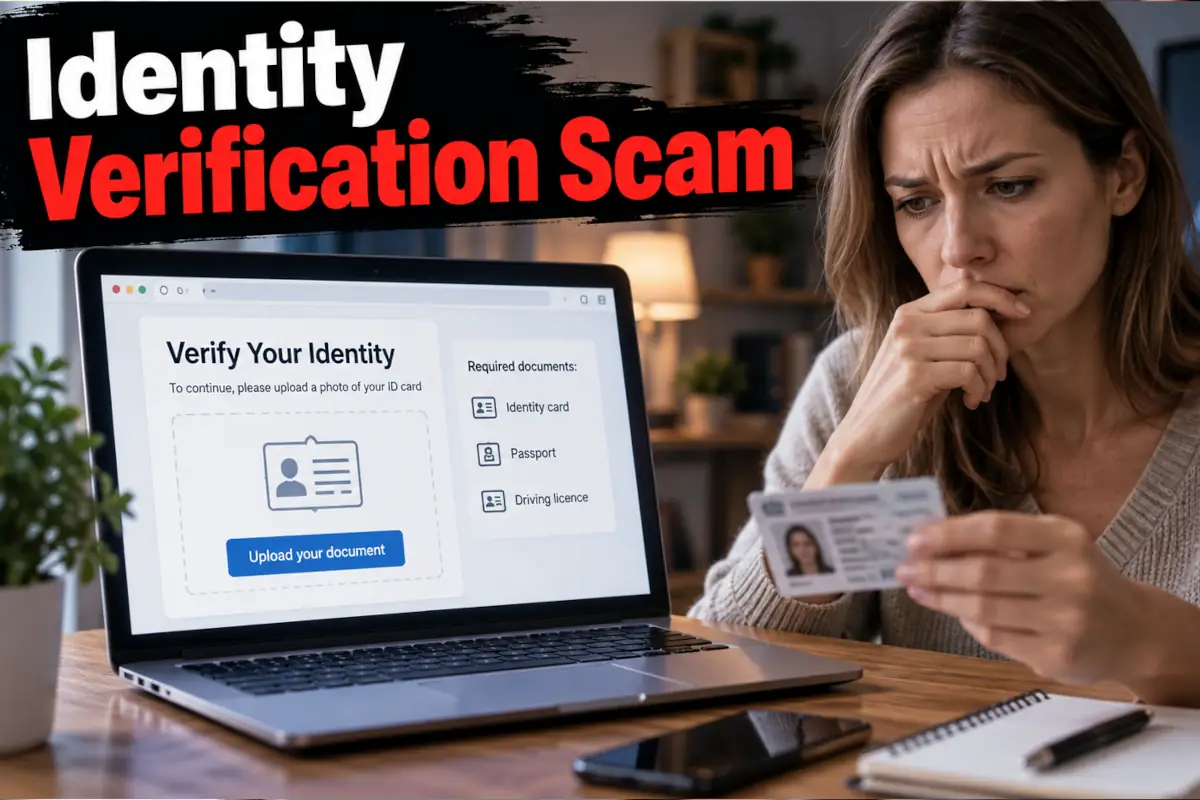 A request for an identity document presented as a simple confirmation can hide an attempt to steal official documents. Scammers collect these copies in order to prepare identity theft.
Stay vigilant: before sending any document, take the time to identify the traps and the right reflexes.
Identity verification scam
Under the pretext of validating a purchase or an account, fraudsters ask for a copy of an identity document or another official document. Once sent without protection, this copy can be used against you.
The method used
The request is presented as a normal confirmation step: you supposedly need to send proof to finalise or maintain an operation. The trap relies on obtaining a clear, complete and reusable file, especially when no security watermark has been added. The information collected can then be used to commit identity theft.
Warning signs: identity document required to “confirm” a purchase or account, request for a raw copy, absence of a security watermark, online transmission of an official document without protection.
A few tips:
- 🛡️ Never send a raw copy of your identity documents: a complete image can be reused.
- ✍️ Add a personalised security watermark to any identity document sent online.
- 🔎 Be wary of verification presented as a formality when it requires sending an official document.
- ⏸️ Before any transmission, keep the reflex of protecting the file rather than sending an unmarked copy.
- 🚨 If an unprotected copy has already been sent, use the relevant official identity-theft protection or reporting services and quickly file a report with law enforcement.
Conclusion
An identity document should never be treated as a simple file to attach. If a verification seems dubious, refuse to send a raw copy, protect the document with a watermark and keep a record of your exchanges.
Reporting this type of attempt on an official website or national platform helps limit its spread; you can also use our anti-fraud reporting assistant and warn those close to you.
To go further:
To strengthen your reflexes or act after a risky transmission, here are some useful resources:
Written by : René Ronse
Sources & Methodology : This alert is based on regular monitoring of national reporting platforms, feedback from victims, statements issued by the relevant authorities and other information available at the time of writing or the latest update. Its purpose is to identify the method used, the warning signs and the appropriate steps to take when faced with this type of fraud.
About the author : René Ronse, manager of ArnaqueOuFiable.com. Expert in consumer cybersecurity, specialist in detecting online fraud, product transparency, and digital compliance. He has over 20 years of experience analyzing hidden subscription mechanisms, unreadable terms and conditions, aggressive sales tactics, and deceptive commercial practices on the web.
Last updated : 18 September 2026.
This article is also available in : Français - Deutsch - Español - Italiano - Nederlands - Português




Consumer Reviews and Testimonials