Blog post: Online security
Hello and welcome to Scam Or Reliable!

Blog post: Online security
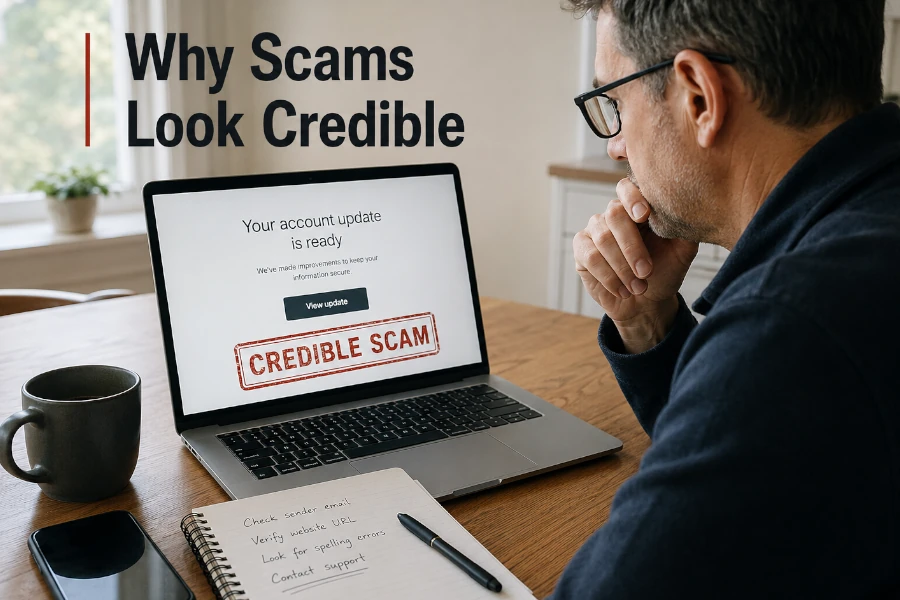
A scam does not work only because it is deceptive. It works mainly because it borrows familiar codes: a known logo, a professional tone, plausible urgency, accurate personal data or a promise consistent with the context. This apparent credibility sometimes leads careful people to lower their guard. Understanding these mechanisms helps identify the trap before confusing a serious appearance with real reliability.
A convincing scam does not always need to be perfect. It may contain a few dubious signs, but appear broadly coherent when the victim discovers it. Scammers rely on the overall impression rather than on a careful check of every detail.
A fake bank message, fake shop or fake government request may seem reliable because it uses several recognisable elements. The name of a known service, a restrained layout, official-sounding wording or a plausible scenario can sometimes be enough to create a feeling of trust. It is not the truth that convinces, but the accumulation of familiar signals.
That is why a person can be trapped without being naive. The scam exploits a situation, a reflex or a specific concern. It fits into a moment when the user thinks they are solving a real problem, checking information or responding to an urgent request.
Fraudsters observe the visual and editorial codes of legitimate services. They copy colours, wording, buttons, forms and user journeys similar to those Internet users already know. A fraudulent page can therefore appear serious, even if its address or purpose is not.
This imitation is not limited to major brands. It can target a bank, a government service, a delivery company, a classified ads platform, a payment service or a local shop. The more familiar the copied model is, the more likely the victim is to focus on the requested action rather than on the real identity of the site.
Official organisations regularly remind people that phishing relies on this confusion. They explain that fraudulent messages seek to deceive victims into sharing sensitive information, which is why it is important to remain vigilant when faced with suspicious messages and fake links.
A scam seems more credible when it imposes a deadline. The message claims that an account will be blocked, that a parcel must be confirmed, that a fine must be paid, that a payment is pending or that an offer will expire quickly. This pressure prevents the user from taking a step back.
Urgency creates an automatic reaction. Instead of analysing the link address, the consistency of the request or the sender’s identity, the victim tries to avoid an immediate consequence. Scammers know that the fear of losing access, paying fees or missing a delivery can be enough to trigger a click.
A legitimate service may sometimes send a reminder, but it should not push you to share sensitive data in a rush. The more urgent a request seems, the more it deserves independent verification. You need to leave the message and access the service through its official website or usual app.
A scam becomes much more convincing when it contains accurate information. A name, phone number, old order, address, supposed bank or service actually used can give the impression that the message is authentic. Yet this data may come from leaks, public sources or previous exchanges.
Scammers do not need to know everything. A few elements are enough to personalise the trap. A message that starts with your first name or mentions a credible context can lower suspicion, even if the final request remains fraudulent.
Personal information should therefore not be considered proof of reliability. The real question lies elsewhere: why is this request arriving now, through this channel, with this link or this pressure? If the answer is not clear, you need to verify it another way.
Scams often rely on common situations. Many people are waiting for a parcel, use online banking, receive bills, look for a job, sell an item or use government services. Fraudsters choose themes that may apply to a large number of recipients.
Even when a message is sent at random, it can arrive at the right time. Someone who is genuinely waiting for a delivery will be more receptive to a fake delivery text. Someone who has just published an advert will pay more attention to a fake buyer. Someone worried about their bank account may more easily believe a fake security message.
This coincidence creates an impression of legitimacy. Yet it confirms nothing. You must always separate the real context from the request received. The fact that a subject concerns you does not mean that the message is authentic.
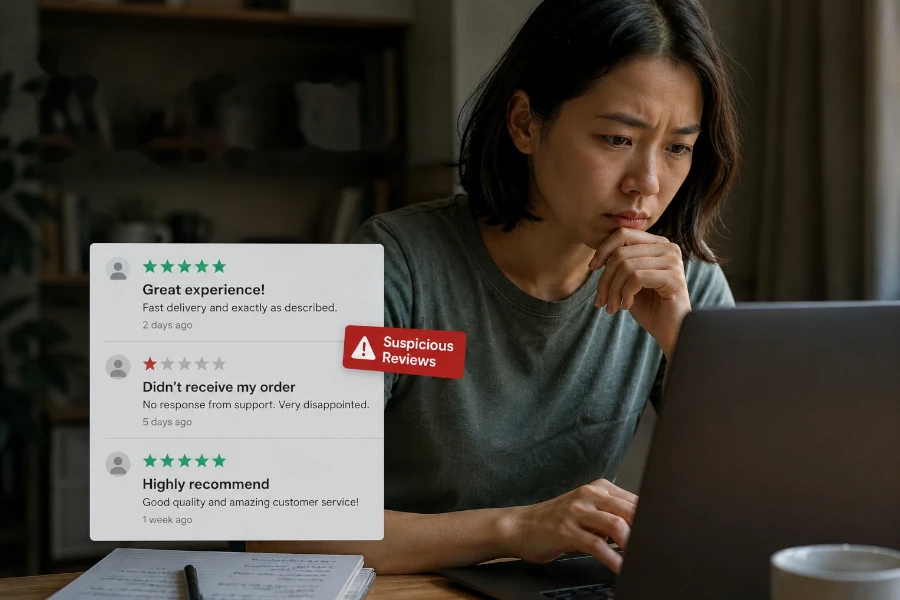
Fake reviews, fake testimonials, fake profiles and fake recommendations strengthen the credibility of a scam. An unknown shop may display positive comments. An investment offer may show fake gains. A fake money recovery service may publish testimonials from victims supposedly reimbursed.
This social proof reassures because it gives the impression that other people have already checked on your behalf. But reviews can be copied, generated, bought or published by the fraudsters themselves. Social networks amplify this phenomenon, because a well-presented setup can seem more convincing than verified information.
You must therefore examine the quality of the evidence. Very recent, overly enthusiastic, vague or identical reviews across several sites should raise concerns. A single testimonial never replaces independent verification of the company, domain, sales terms or real contact details.
Modern scams often use clean, structured and reassuring language. Some obvious mistakes still exist, but they are no longer a sufficient criterion. A fraudulent message can be well written, polite, coherent and visually polished.
This evolution makes traps harder to identify. Translation tools, message templates and automation make it possible to produce more credible content. The absence of mistakes should therefore not be interpreted as proof of authenticity.
You need to look at the request rather than only the form. A message may be well presented and still ask you for a password, verification code, bank card or unjustified payment. The quality of the text never compensates for an inconsistent request.
It is important not to reduce a scam to an individual mistake. Scammers use methods designed to exploit urgency, trust, fear, hope or fatigue. Their goal is precisely to provoke a quick decision before critical thinking takes over again.
Guilt can prevent victims from asking for help or reporting the facts. Yet reacting quickly is often more useful than hiding the incident. A well-constructed scam can deceive a careful person, especially if it arrives at the wrong moment.
Recognising this reality does not mean accepting everything. On the contrary, it makes it possible to adopt a more effective method: slow down, verify, compare and never rely on a single signal of credibility. Prevention works better when it is based on simple reflexes rather than shame.
The best defence is to create a pause. Before clicking, paying, replying or sharing information, you need to step out of the scenario imposed by the scammer. This pause allows you to check the address, sender, request and channel used.
A good reflex is to seek confirmation through an independent route. For a bank, open the official app. For a government service, type the known address into your browser. For a company, check the legal notices, terms, domain history and external reviews. For a message received from someone close to you, contact them through another channel.
A scam can seem credible because it imitates known codes, relies on a plausible context and pushes people to act before checking. It can contain real information, professional language and a reassuring appearance without being reliable. The right reflex is never to confuse apparent coherence with real proof.
To strengthen your reflexes, read our guide on the habits that reduce the risk of scams. If you want to train yourself to recognise weak signals, the interactive fraud-awareness simulator can help you test your reactions. And if you have already been trapped, our post-fraud guidance guide helps you choose the first useful steps.