Blog post: Online security
Hello and welcome to Scam Or Reliable!

Blog post: Online security
 Online comparison sites can help you choose insurance, an energy offer, a loan, travel, a subscription or a digital service. But they do not all play the same role: some genuinely inform users, while others mainly steer them toward paying partners.
The risk is not always a direct scam, but a biased decision caused by an opaque ranking, incomplete prices or abusive data collection.
Understanding how a comparison site works helps prevent people from confusing decision support with a disguised sales funnel.
A serious comparison site can save time. It brings together several offers, makes it possible to view prices, guarantees, conditions or fees, and provides an initial picture of the market. In some complex sectors, such as insurance, energy, credit or telecoms, this summary can genuinely help consumers.
The problem arises when the site gives the impression that it compares the whole market while it actually lists only a limited selection of providers. A result placed at the top of the page may be presented as “best” when it is mainly sponsored, a partner offer or simply more profitable for the site. The ranking then becomes less an information tool than a mechanism for commercial steering.
In the United Kingdom, the Competition and Markets Authority highlights the importance of price transparency throughout the purchasing journey, especially in markets where consumers struggle to search and compare options. In the United States, the CFPB has warned that digital comparison-shopping tools may present ordered recommendations or rankings influenced by provider compensation or other commercial benefits. These issues are explained on gov.uk / CMA (UK) and CFPB (US).
Some sites do not primarily try to compare offers, but to collect information. They ask for a name, an email address, a phone number, a ZIP code, family situation, income, a credit need or information about a home. Some of this data may then be used for marketing or passed on to partners.
The collection is not necessarily illegal in itself. It becomes problematic when the user does not clearly understand who receives the data, for what purpose, for how long and with what consequences. A form presented as a simple simulation may in reality open the door to repeated sales calls.
The most important warning sign is the imbalance between the promise and the request. If a site demands a large amount of personal data before even displaying the slightest useful information, you need to question it. A transparent comparison site should explain why this data is necessary and make it possible to clearly identify the entity responsible for the service.
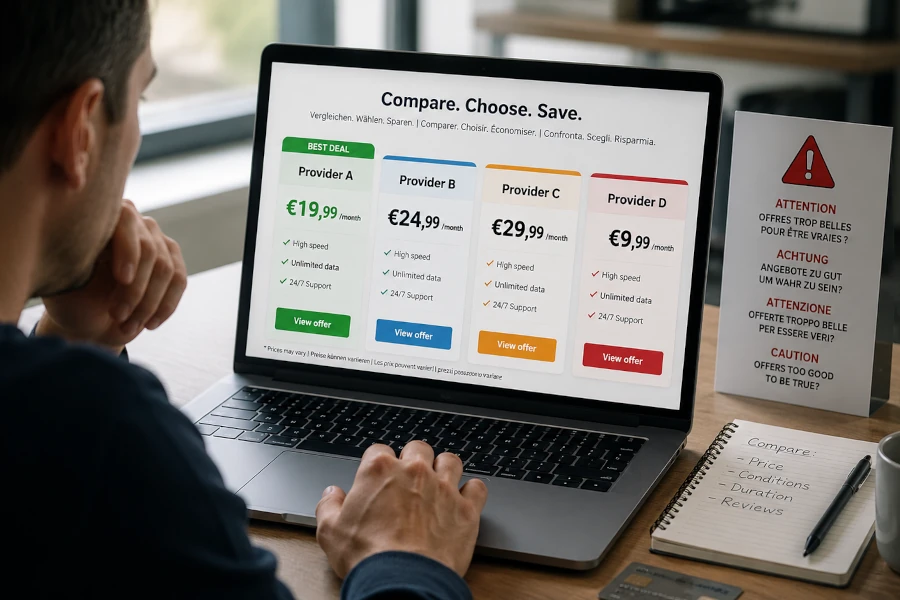 A ranking can seem objective because it is presented in the form of a table, a score, stars or a “top 10”. Yet that presentation does not guarantee impartiality. The first result may depend on a partnership, a commission, an advertising budget or an unexplained editorial choice.
Official sources in both the UK and the US warn that comparison and recommendation tools can influence consumer decisions through the way prices, rankings and options are presented. When ranking criteria, commercial relationships or the real scope of the comparison are unclear, the impression of neutrality can be misleading.
When these elements are missing, difficult to find or written in vague terms, caution is necessary. A comparison site that does not clearly explain how it makes money should not be treated as neutral. That does not automatically mean it is fraudulent, but it does reduce the level of trust you can place in its ranking.
Fake or biased comparison sites mainly appear in areas where the decision involves money, personal data or a long-term contract. Consumers are not looking only for a low price, but also for a guarantee, after-sales service, commitment length, exclusions, fees or cancellation terms. That complexity is precisely what makes rankings easy to manipulate.
In the United Kingdom, Ofgem (UK) provides information on accredited price comparison websites for gas and electricity. In the United States, energy offer comparison is often handled at state level through local regulators, utilities or consumer protection channels rather than through one nationwide official comparator, which is why checking the appropriate local authority remains essential. One official starting point is USA.gov (US).
The sectors that deserve especially close attention are:
A dubious comparison site is not always obvious at first glance. It may have a clean interface, clear tables and reassuring buttons. The weaker signals are more often found in the legal notices, the ranking criteria, the data-sharing conditions and the way offers are presented.
A first warning sign is the absence of information about how the service works. The site should explain whether it compares the whole market or only certain partners. It should also indicate whether the ranking depends on price, a score, compensation, popularity or another criterion.
A second warning sign is artificial urgency. If the comparison site displays messages such as “offer valid for a few minutes”, “last chance” or “rate reserved now”, it may be trying to accelerate the decision. In a serious comparison process, the user should be able to read, verify and leave the page without pressure.

The first step is to consult the legal notices and the page explaining how the comparison site works. You should find the publisher’s identity, the ranking criteria, the listing conditions, the possible presence of paid partners and whether the results are exhaustive or not. If this information is missing, the ranking should be treated with caution.
The second step is to repeat the comparison elsewhere. One single comparison site is not always enough, especially in a costly or binding sector. It is better to check directly on the professional’s website, use an official comparison tool when one exists, and read the contractual terms before sharing data or signing up.
The third step is to look at the full price. An offer that seems cheaper on the first screen may hide fees, a commitment period, later price changes, exclusions or pre-ticked options. In a reliable comparison, the essential elements should be visible and understandable before the decision is made.
If a comparison site seems misleading, start by keeping the evidence. Screenshots, URLs, displayed conditions, received emails, advertised prices and the final price may all be useful. These elements make it possible to document the difference between the initial promise and the reality.
In the United Kingdom, suspicious websites, phishing attempts or online scam content can be reported through NCSC (UK), while fraud and cyber crime reports can be directed to Report Fraud (UK). In the United States, consumers can use ReportFraud.ftc.gov (US) and USA.gov (US) to identify the right reporting channel depending on the situation. For a difficulty linked more specifically to financial products or services, the CFPB (US) may also be relevant.
If your personal data has been submitted, monitor the solicitations that follow. Calls, emails or texts linked to the compared topic may appear quickly. It is then useful to ask where the contact details came from, refuse any commercial pressure and never agree to a contract by phone without a clear and verified document.
Online comparison sites should not be rejected, but they should not be used as neutral referees without verification either. Their reliability depends on their transparency, their ranking criteria, their commercial links and their handling of personal data. A good comparison site helps people understand the market; a dubious comparison site mainly pushes them toward a quick decision.
Before choosing an offer, it can be useful to review the principles of caution before an online purchase or sign-up. To strengthen your reflexes against persuasion techniques, also see the practical guidelines for reducing scam risks.
👉 If you think you have been misled, the interactive guide for scam victims can help prioritize the right actions to take.
👉 If you think you have been directed toward a fraudulent offer, the guidance assistant for reporting fraud can help identify the right channel.
👉 You can also test your reflexes with the interactive fraud simulator to better identify warning signs in the most common high-risk situations.