Blog post: Online security
Hello and welcome to Scam Or Reliable!

Blog post: Online security
 Older people are regularly targeted by scams that exploit urgency, trust in institutions or concern for someone close. Phone calls, SMS messages, emails and doorstep visits can now be combined in particularly credible scenarios. Artificial intelligence can also reinforce certain manipulations by making it possible to imitate a voice or create fake content.
Knowing the methods used remains one of the most effective ways to interrupt the scam before any payment is made or data is shared.
Fraudsters do not rely only on the age of their victim, but above all look for a situation in which they can quickly establish trust or provoke a strong emotion. They often use the identity of a bank, the police, a public authority, a technician or a family member. In the United Kingdom and the United States, official warnings still regularly describe scenarios in which older people are contacted directly by phone and then pushed to hand over a bank card, codes or valuables.
The strategy generally relies on three elements: a credible story, immediate pressure and the implicit or explicit prohibition on taking time to verify. The fraudster wants to prevent their target from calling a relative, their bank or the organisation they claim to represent. As soon as someone demands an immediate decision involving money or confidential information, caution must come first.
Methods evolve, but the psychological mechanisms often remain the same. An emergency is created artificially so that the victim acts before they have been able to think or ask for advice. The same scenarios can circulate simultaneously in the United Kingdom and the United States by simply adapting the name of the bank, public authority or local service used as cover.
 The so-called grandchild, grandparents or loved-one-in-distress scam has existed for a long time. A caller claims to be a child or grandchild facing an accident, an arrest, hospitalisation or another emergency requiring money immediately. One variant begins with an SMS message saying that the loved one has changed phone and that communication must now continue through a new number.
Artificial intelligence now adds an additional possibility: tools can reproduce or modify a voice to make a call more convincing. This does not mean that all loved-one scams use AI, but the voice heard on the phone can no longer constitute proof of identity by itself. The safest reflex is to hang up and then call the person concerned directly on their usual number.
This fraud is currently documented in several countries and frequently targets older people. A caller claims that a suspicious operation has just been detected and says they must act immediately to protect the account. They may know the victim’s name, bank or certain personal information, and the number displayed on the phone may sometimes seem legitimate.
The next step usually consists of asking for security codes, making the victim approve a banking operation or announcing that a collaborator will come to the home. This supposed employee, police officer or courier then comes to collect a bank card, sometimes with its code, an authentication device or even valuables. A bank or police service does not ask a private individual to hand over their card and code in this way to someone sent to their home.
An alarming window may suddenly appear on a computer claiming that a virus, hacking or serious security problem has just been detected. A phone number is then presented as that of a technical service responsible for solving the problem immediately. After making contact, the victim is generally invited to install a program giving remote access to their computer.
The fraudster can then observe the screen, collect information, manipulate the victim or encourage them to carry out banking operations. The message displayed on the computer is not proof that a real technician has detected a problem. You should never install remote-control software at the request of an unknown caller or because a number appears in an unexpected alert.
Fraudulent messages regularly imitate banks, delivery services, tax authorities, social services or other well-known services. Some announce a payment problem, a refund, a benefit to renew or an urgent formality. Others use the scenario of a loved one who has lost or changed their phone in order to gradually start a conversation.
The names of the organisations change depending on the country, but the objective remains the same: trigger a click, collect login details or obtain a payment. A link contained in an unexpected message should therefore not be used to access a bank or public service. It is better to open the official app yourself or directly enter the usual address of the service concerned.
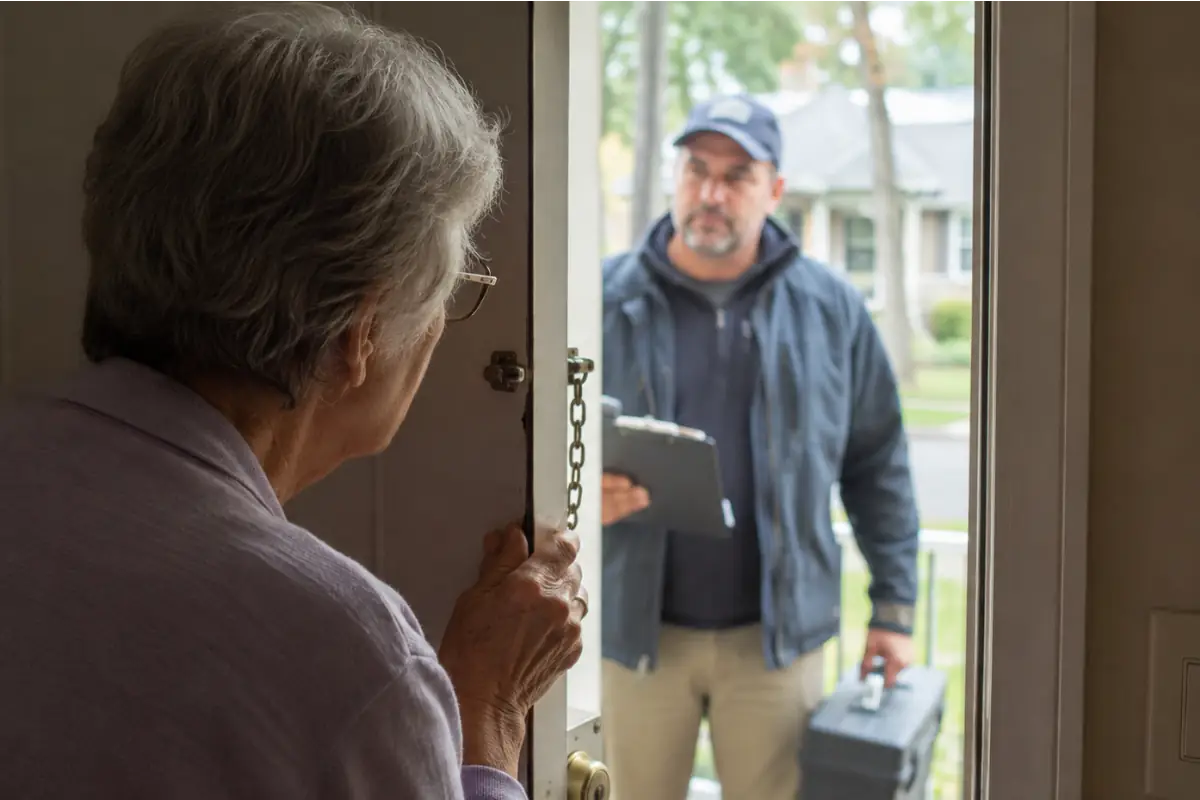 Some fraudsters abandon the Internet entirely and go directly to their target’s home. They may pose as police officers, water company agents, energy supplier employees, local authority workers, roofers or other professionals. A fake urgent problem is then used as a pretext to enter the home, distract attention or propose unnecessary works.
An unsolicited visit must always be verifiable before you let someone in. A professional card shown quickly is not a sufficient guarantee, because it can be falsified. When the person claims to work for a company or public authority, it is preferable to close the door and contact the organisation yourself using contact details obtained independently.
The scenarios differ, but several signs come up constantly. One of these elements alone does not automatically prove fraud, but their accumulation should trigger independent verification. The most important common point is the attempt to prevent the victim from taking time to think.
The best defence is often to deliberately interrupt the situation created by the scammer. A few minutes of verification are enough to make the artificial urgency on which many of these frauds rely disappear. These habits are useful for seniors, but also for the whole family.
 A quick response can limit some consequences, even when a payment has already been made. The first priority is generally to contact the bank or payment institution concerned in order to report the fraud and secure the payment methods. You should then keep the elements that help understand how the scam unfolded rather than immediately deleting the messages.
The systems are not identical from one country to another. A victim must first warn their bank when a payment or banking data is involved, then use the appropriate official services. Attempts can also be reported when no financial loss has yet occurred, because they can help identify a wider campaign.
Scams targeting seniors are becoming more credible, but their fundamental principles remain relatively constant: create urgency, impersonate a reassuring identity and prevent any independent verification. New technologies can reinforce certain scenarios, notably with manipulated voices or images, but the most effective reflex remains simple: interrupt the conversation and verify the situation through another channel.
When doubt remains, our guide for victims of scams helps determine the first useful actions. Our assistant for reporting guidance can also help identify the steps suited to the situation. To train your reflexes before facing a real attempt, the fraud scenario simulator lets you test your vigilance against different scenarios.