Blog post: Online security
Hello and welcome to Scam Or Reliable!

Blog post: Online security
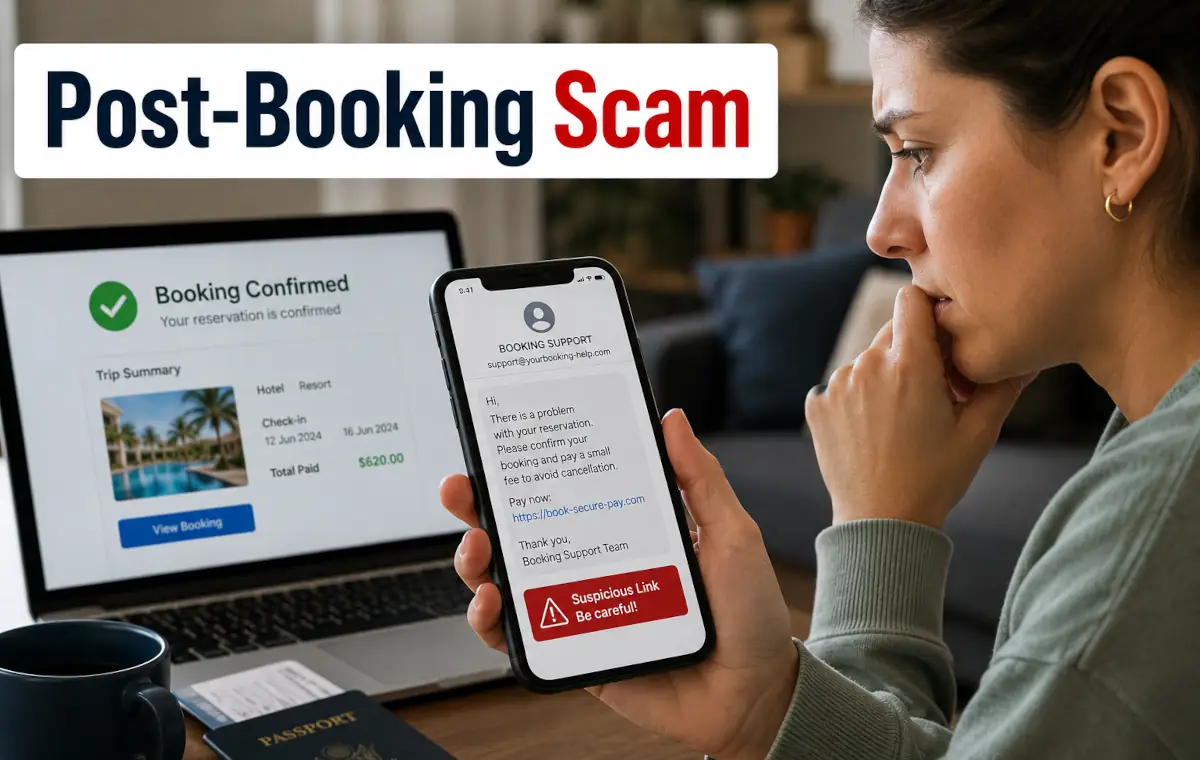
A recent scam targets travellers just after an online booking, at a time when they naturally expect to receive messages related to their stay. Alerts report this type of trap targeting users of booking platforms. The particular feature of this fraud is that it does not start with fake accommodation, but exploits a booking that has already been made to make the approach more credible. The danger mainly comes from the context: the victim has genuinely just booked and is more likely to lower their guard.
The post-booking scam relies on a subtle shift: the traveller is not contacted at random, but contacted after they have just completed a real action. In their mind, any exchange received at that moment may seem linked to the booking in progress. This close timing creates a climate of trust that can lead them to click, reply or provide information without applying the usual checks.
This type of fraud differs from fake accommodation listings. With fake accommodation, the trap is often set before payment or before confirmation, when the user is looking for an offer. Here, the scam takes place after the booking, when the person already thinks they are involved in a legitimate process. It is precisely this change in timing that makes the scenario harder to spot.
The traveller may think that the message received concerns a formality, a confirmation, a detail or a request linked to the stay. Even if the exact content varies from case to case, the psychological mechanism remains the same: exploiting a recent action to reduce doubt. The more the request seems to arrive at the right time, the more normal it may appear.
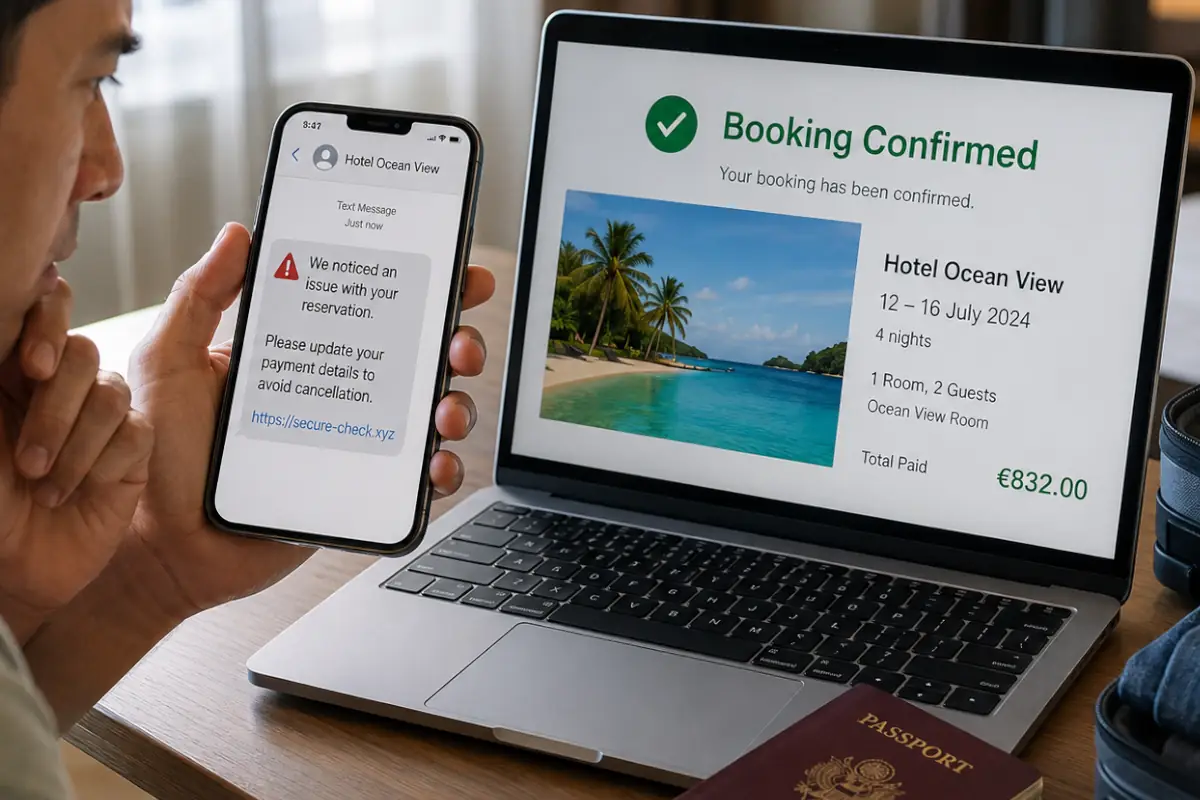 After a booking, it is common to expect additional information. The traveller may be checking their messages, verifying times, rereading the details of the stay or looking for practical instructions. Fraudsters exploit this attention, because the person is already focused on their trip and ready to deal with communications linked to the journey.
Credibility does not necessarily come from a perfectly written or technically sophisticated message. It comes first from the apparent consistency between the moment of receipt and the recent action. When contact occurs just after a booking, the brain naturally tries to link it to that booking. This quick association may be enough to weaken caution.
The other difficulty is that the victim does not necessarily feel they are dealing with an unknown solicitation. They may think they are continuing a normal exchange, which changes the way they assess risk. A request that would seem suspicious in ordinary circumstances may seem acceptable when it arrives in the middle of a booking process.
The first reflex is to slow down. A scam of this type often seeks to exploit haste, emotion or fear that the booking may be compromised. Even when the message seems consistent with a recent trip, it should be treated as a request to verify, not as an automatic instruction.
Caution should apply to the content, but also to the channel used. A contact received outside the usual booking environment, an unusual request or a link that invites quick action should be examined carefully. Without immediately concluding that it is fraud, these elements at least justify independent verification.
It is also useful to compare the message with the information already available in the booking confirmation. An inconsistency in tone, vague wording, unusual pressure or a request that does not match what was planned may indicate an attempt at exploitation. The goal is not to panic, but to regain control before taking any action.
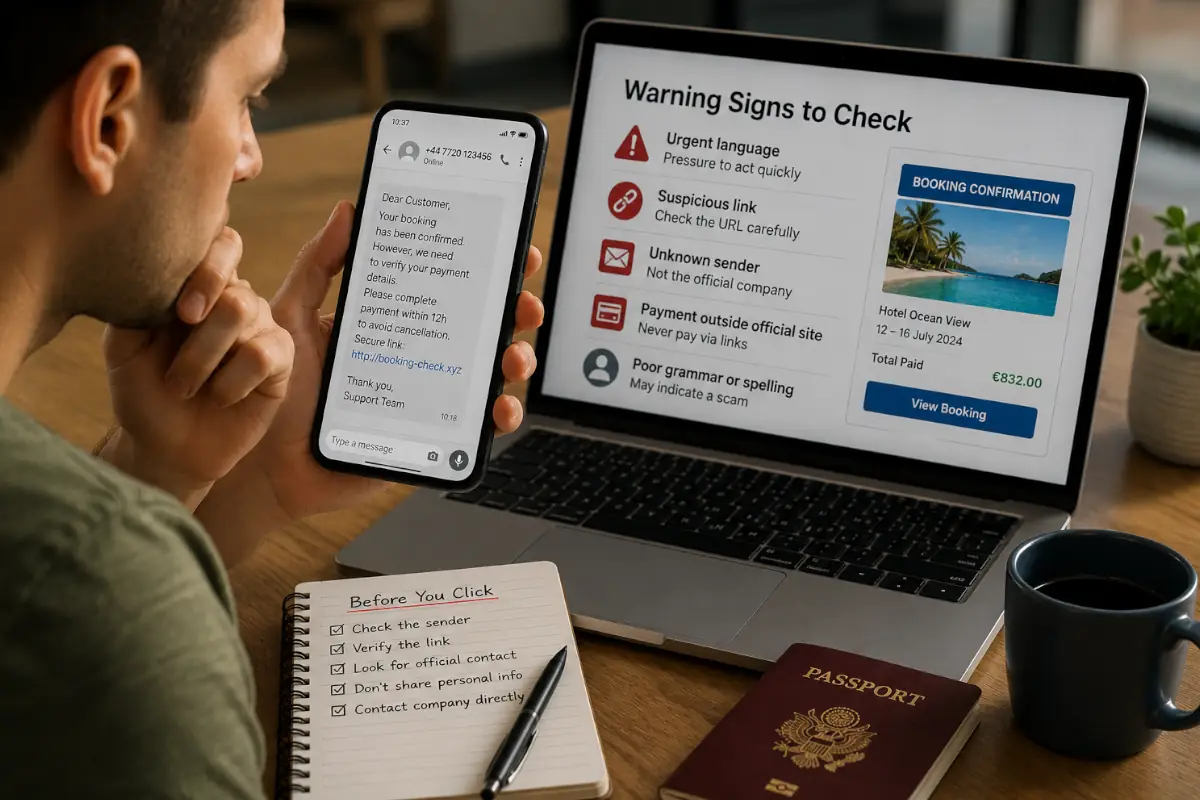 In this type of scenario, the aim is not only to make people believe in a fake listing. The fraudster tries to insert a parasitic step into a process that already exists. This step may take the form of a request presented as necessary, urgent or linked to the smooth running of the trip.
The mechanism is effective because it relies on a real situation. The traveller has booked, is waiting for updates and wants to avoid any problem. This combination can make them more receptive to a request they would have ignored in another context.
Two questions must therefore be distinguished. The first is whether the booking really exists, which may be the case. The second is to check whether the message received afterwards is genuinely part of the normal process. An authentic booking does not automatically make every subsequent contact legitimate.
The best protection is to create a pause between receiving the message and taking the requested action. Even a few minutes of distance can be enough to spot an inconsistency. It is better to go back to the booking area yourself rather than use a link received in an unexpected message.
You should also avoid transferring information or carrying out an operation under pressure. A request linked to travel may seem urgent, especially if it mentions a confirmation, an update or a risk of a problem. Yet the stronger the pressure, the more rigorous the verification should be.
When doubt remains, the safest approach is to seek confirmation through a channel already identified. This separates the suspicious message from the real booking. The traveller therefore keeps control of the situation instead of following a path imposed by an unknown contact.
 If a reply has already been sent, avoid multiplying exchanges. The first objective is to limit any additional information that could be shared. It is also important to keep the elements available, because they can help understand the scenario and make a report if necessary.
The response depends on what has been shared. A simple text reply does not have the same consequences as clicking on a link or transmitting more sensitive information. In all cases, it is useful to document the facts with screenshots, dates, the content received and any actions taken.
If there is serious doubt, it may be relevant to ask for help through suitable anti-fraud resources. The essential point is not to remain alone in a confusing situation. Fraud that exploits a recent booking can be destabilising precisely because it blurs the line between a legitimate exchange and manipulation.
The confusion is understandable, because both subjects involve travel and online booking. However, the prevention angle is not the same. In the case of fake accommodation, the main risk is often at the stage of choosing the listing, whereas the post-booking scam relies on an action that has already been validated.
This difference changes the way to protect yourself. Before a booking, you mainly check the consistency of the listing, the conditions and the information available. After a booking, you must mainly monitor the messages received, the links suggested and the requests that seem to attach themselves to the existing file.
Vigilance must therefore continue after confirmation. Many users consider that the main risk has passed once the booking has been made. Yet recent alerts show precisely the importance of remaining attentive in the hours or days following an online process.
An effective routine must be easy to apply, even while travelling. The idea is not to suspect every message, but to verify requests that fall outside the expected framework. This method avoids making a decision under the effect of urgency or trust linked to the recent booking.
The principle is to separate three things: the message received, the real booking and the action requested. The message may mention a trip, the booking may exist, but the requested action may still be fraudulent. By keeping these three elements separate, the traveller reduces the risk of following a false logic.
It is also useful to apply the same reflexes to all travel-related communications. A credible message is not necessarily reliable, and a coherent context is not enough to validate a request. Security relies on verification, not on the overall impression.
The post-booking scam is particularly deceptive because it happens when the traveller thinks they are in a normal exchange. The fact that they have genuinely booked strengthens the credibility of the trap, but it does not guarantee that every message received afterwards is legitimate. The right approach is to slow down, check the channel used, avoid unexpected links and keep evidence if in doubt.
To strengthen your reflexes, you can consult this guide on the good habits to adopt against scams. If you have received a dubious link, a tool such as the analysis of a suspicious address can help assess the risk before clicking. And if you think you have been trapped, step-by-step support for victims can help you organise your first actions.