Blog post: Online security
Hello and welcome to Scam Or Reliable!

Blog post: Online security
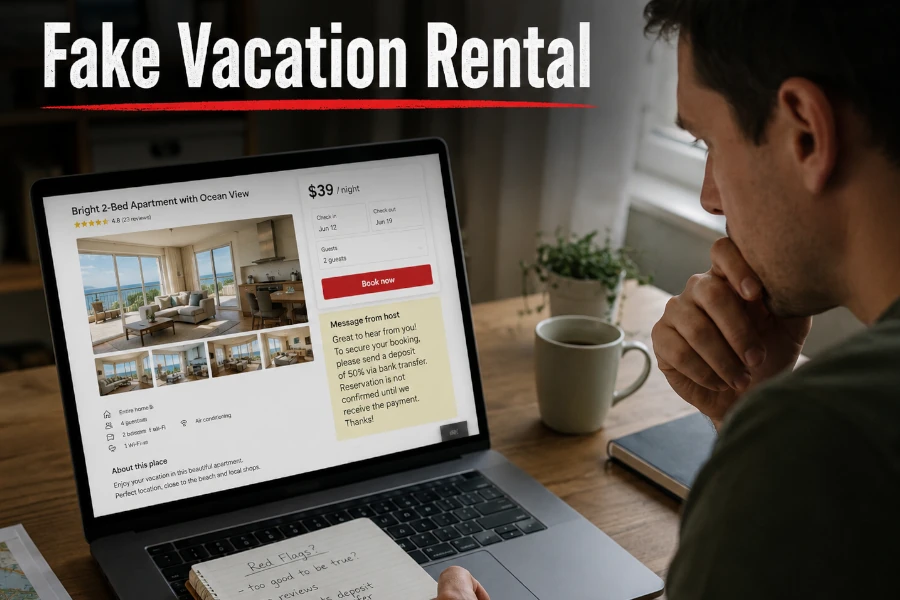
Holiday rental scams target travellers when they are looking for accommodation that is available, well located and offered at a reasonable price. The trap often relies on a copied listing, a credible fake owner or a deposit request presented as urgent. Before booking, a few simple checks can help spot many suspicious signs. The aim is not to distrust every listing, but to recognise those mainly designed to make you pay quickly.
Holiday periods create a context that encourages quick decisions. When accommodation becomes scarce, a well-located listing, with attractive photos and an appealing price, can make it feel as though you need to book immediately. Fraudsters exploit this pressure to reduce thinking time and prevent normal checks.
The most common scenario consists of reusing photos from a real property and then publishing a listing elsewhere with a different contact. The property may sometimes really exist, but the person collecting the money has no right to rent it out. In other cases, the accommodation is entirely fictitious or the address corresponds to a place unrelated to the listing.
The fake owner may also send a contract, a copy of an ID document or a very polite message to appear serious. These elements do not necessarily prove that the rental is real. An identity can be stolen, a contract can be copied and a document can be used only to reassure the victim.
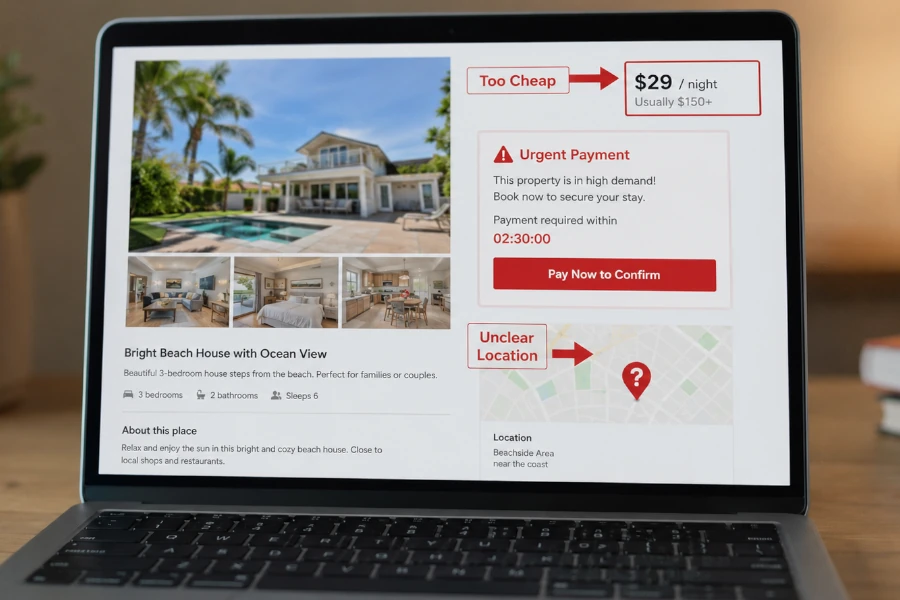
A fraudulent listing is not always crude. Some reuse detailed descriptions, consistent photos and a professional tone. You therefore need to look at the whole context rather than one isolated element.
A price far below similar listings in the same area should attract attention. It is not proof of a scam, but it is often an effective lure. The risk increases if the owner refuses normal exchanges, avoids precise questions or pushes for quick payment.
Requests for payment outside the platform are also sensitive. A direct bank transfer, money transfer or unusual payment request reduces your options for recourse. If the listing was found on a known platform, staying within its messaging and payment system generally limits the risks.
The first check is to compare the listing with other sources. Search for the address, an exact sentence from the description or an image of the property. If the same photos appear on another site with a different price, city or contact, you should pause the booking.
It is also useful to ask concrete questions. Ask for details about access, the floor, facilities, the neighbourhood or arrival arrangements. A real host generally knows their property, whereas a fraudster often answers vaguely or avoids verifiable details.
When the booking goes through a platform, avoid leaving the intended framework. A scammer may claim they want to avoid fees or offer a discount in exchange for direct payment. This apparent saving can cost far more if the accommodation does not exist or if the listing disappears after payment.
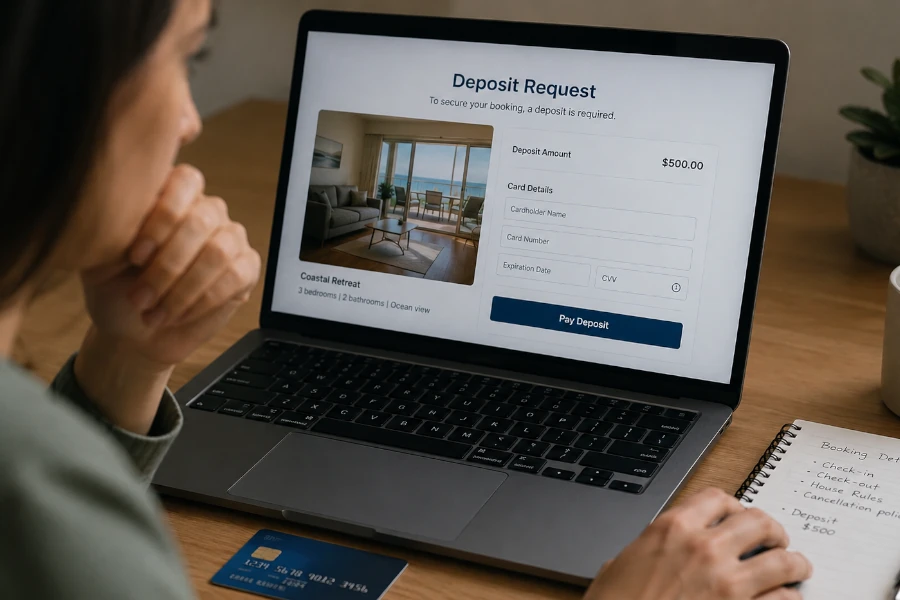
The deposit is often the decisive moment in the scam. The fraudster tries to obtain money before the victim discovers the inconsistency in the listing. They may present the payment as a simple guarantee, a temporary reservation or an essential condition to block the accommodation.
A contract is not enough to secure the transaction. It may be incomplete, contain a copied address or use the identity of a real person without their consent. The most important point is to check that the host, the accommodation and the payment method form a coherent whole.
Official consumer and fraud resources remind travellers to be cautious about sums paid, the description of the property and booking conditions. Before paying, consulting resources such as the CMA information on holiday accommodation (UK), Action Fraud’s guidance on holiday fraud (UK) or the FTC’s information on rental listing scams (US) can help you better understand the terms used.
Even when a listing appears reliable, it is wise to keep evidence. These elements may be useful in the event of a dispute, a report or a request to the bank. Screenshots should be taken before the listing potentially disappears.
Keep the full exchanges, not just the latest messages. Contact details, promises, payment requests and links sent can help explain the scenario. Evidence is especially important if the fraudster then deletes their profile or modifies the listing.
Also keep bank details or payment references. They should not be published online, but should be kept in a separate folder. In the event of a scam, these elements can help you explain the situation clearly.
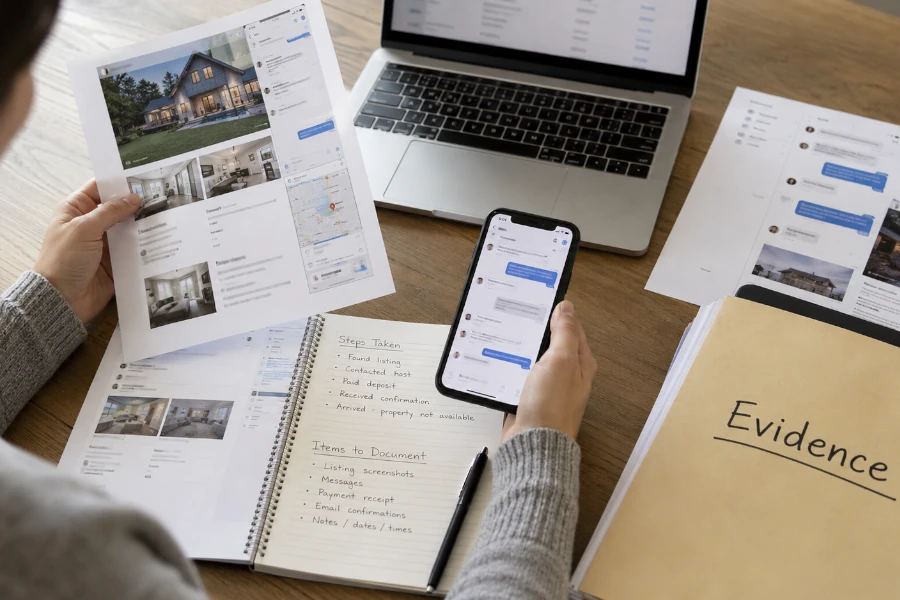
If you think you have paid for a fake rental, act quickly without panicking. Contact your bank to explain the situation and ask what options are still possible depending on the payment method used. Possibilities vary according to the type of transaction, the time elapsed and the information available.
Then report the listing to the platform or site concerned. Provide precise elements so it can check the profile, block the listing or prevent other victims from falling into the same trap. If the fraud involves a fake site or identity theft, the report can also help document the pattern.
Official reporting services recommend keeping the available evidence in the event of a holiday rental scam. You can consult Action Fraud’s advice on holiday fraud (UK) and report fraud through ReportFraud.ftc.gov (US). For digital fraud or suspicious messages, you can also use the NCSC’s phishing and suspicious message guidance (UK).
The first mistake is to believe that an attractive listing is enough to prove the existence of a real property. Fraudsters deliberately use appealing photos to create an impression of seriousness. A visually polished listing can be copied in minutes.
The second mistake is to confuse speed with security. A host who strongly insists on immediate payment should not be followed without verification. Pressure is a classic mechanism in scams, because it pushes people to act before thinking.
The third mistake is to reassure yourself solely with an ID document or a contract. These elements may be real, fake or stolen. The right approach is to cross-check several indicators: listing, address, identity, payment, reviews, history and consistency of the exchanges.
Holiday rental scams rely less on technical complexity than on haste, trust and the fear of missing a good opportunity. Before paying, take the time to compare the listing, check the photos, stay within secure channels and refuse unusual requests. A serious booking can generally withstand a few simple questions.
To strengthen your reflexes, you can consult our practical advice to avoid the most common traps. If you have already paid or shared information, our support pathway for scam victims can guide you according to your situation. And if the listing or message contains a doubtful link, the suspicious URL checker can help you spot some visible warning signs before clicking.