Blog post: Online security
Hello and welcome to Scam Or Reliable!

Blog post: Online security

Online fundraisers make it possible to quickly support a person, family or cause, but this simplicity also attracts fraudsters. Some campaigns are created around invented stories, stolen photos or emergencies presented as too urgent to wait. The trap works because it appeals to emotion before verification. Yet a few simple checks are often enough to spot a dubious fundraiser before donating.
A fake fundraiser does not always look like a clumsy or obviously suspicious request. It may reproduce the features of a genuine appeal: a moving story, a powerful photo, a fundraising target, messages of support and sometimes widespread sharing on social media. The potential donor sees a cause that seems urgent and is pushed to contribute quickly, sometimes without knowing the organiser or the supposed beneficiary.
The principle remains simple: a malicious person creates or shares a fundraising campaign based on a fabricated, misappropriated or stolen story. The money collected does not serve the cause displayed and instead ends up in the fraudsters’ pockets. This type of scam is particularly difficult to accept because it exploits generosity, compassion and the trust placed in relatives, friends or online communities.
Recent tragedies, accidents, fires, natural disasters, humanitarian crises or medical emergencies are frequently used as themes. The more widely reported or emotionally powerful the event, the faster a fundraiser can spread. This speed of circulation is precisely what fraudsters seek: they rely on the wave of solidarity before Internet users have time to verify the origin of the request.
Scammers often begin by constructing a story capable of triggering an immediate reaction. A serious illness, sudden accident, family fire or disaster that occurred only hours earlier creates a sense of urgency and seriousness. The text may deliberately remain vague about certain details while emphasising suffering, distress and the need to act quickly.
To strengthen the credibility of the fundraiser, fraudsters may steal photos found elsewhere, use the identity of a real victim or invent testimonials. An authentic image taken out of context can be enough to make a false story much more convincing. In some cases, the name of a real person is used without permission, further blurring the line between a legitimate fundraiser and a scam.
Distribution then plays a central role. The fundraiser is shared by SMS, email or through posts circulated widely on social media. The more the message arrives through a personal or community channel, the more trustworthy it may seem, even if the person sharing it has not verified the origin of the fundraiser themselves.
Fraudsters rarely want to leave time for reflection. They use wording that encourages people to donate immediately, share without delay or not to “abandon” the supposed victim. This climate of urgency reduces spontaneous checks and increases the risk of an impulsive contribution.
 A fraudulent fundraiser is not always exposed by an obvious mistake. It may be well written, accompanied by sympathetic comments and shared by people acting in good faith. Vigilance therefore means looking at all the clues, especially when the identity of the organiser, their connection with the beneficiary or the exact use of the funds is unclear.
A highly emotional story that contains few verifiable details should attract attention. Compassion is not a substitute for evidence, especially when money is being requested from strangers. The concern becomes even greater if the fundraiser appears immediately after a widely reported event and spreads very quickly.
Photos also deserve particular attention. An image may come from another story, an older event or a profile that has no connection with the fundraiser. A reverse image search can sometimes reveal that a photo has already been used elsewhere, which is a strong sign of impersonation or misuse.
 Before contributing to a fundraiser, the first question to ask concerns the organiser. Their name, real connection with the person being helped and presence on the platform should be consistent. A fundraiser may be genuine, but if no one can clearly explain who is collecting the money and why, caution is necessary.
The platform may also provide useful information about the campaign creator or how payments work. These details do not automatically guarantee that a request is legitimate, but they help clarify the framework in which the money is being collected. When the situation remains unclear, asking for specific supporting information is a normal precaution, even if the story is moving.
For disasters, humanitarian crises or widely reported events, it is better to favour official organisations, recognised charities and the websites of the relevant authorities. An individual fundraiser may exist alongside them, but it should be verifiable. Donating to a clearly identifiable organisation reduces the risk of funding an opportunistic campaign created in haste.
A useful test is to ask yourself whether you could explain to someone close to you why this fundraiser is reliable. If the answer relies only on emotion, the number of shares or trust in the person who forwarded the link, a verification step is probably missing. Caution does not mean refusing to help, but making sure that the help really reaches the person or cause described.
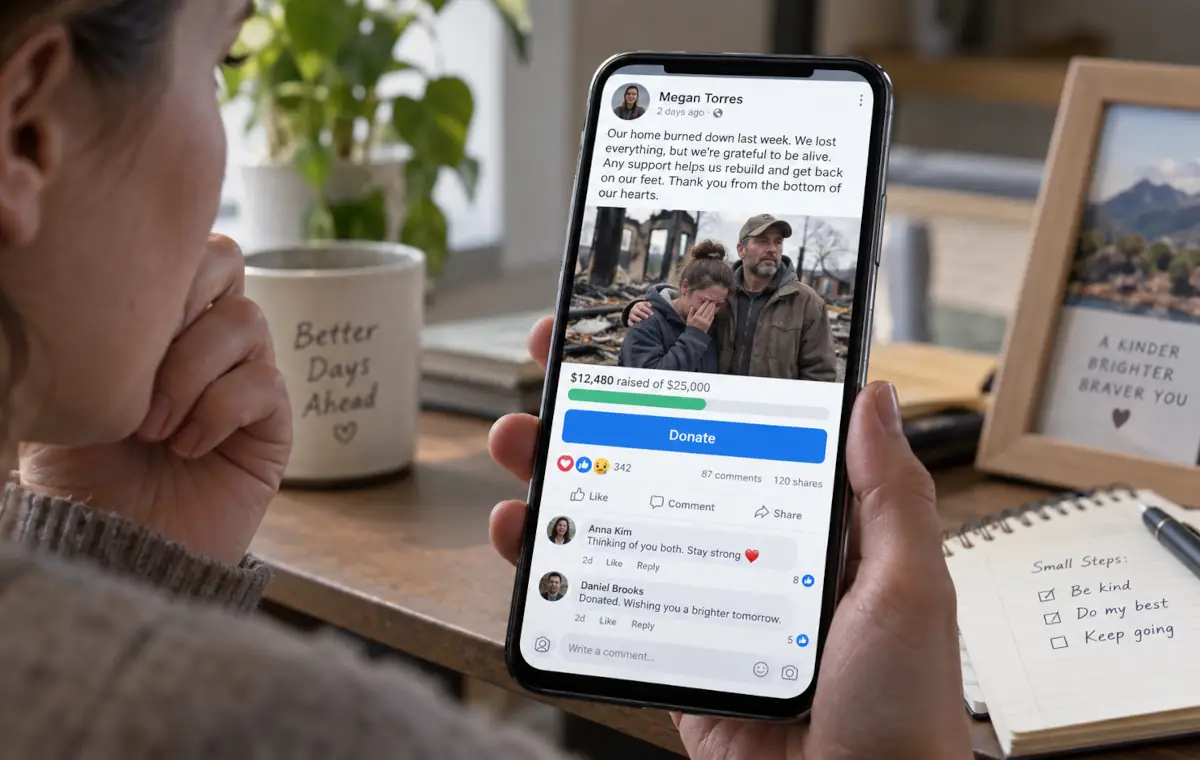 Social media can give fundraisers very rapid visibility, including when they have not been verified. A message shared by several accounts can create an impression of legitimacy, even though each person sharing it may simply be relying on the previous share. The chain of trust becomes fragile: no one wants to interrupt a wave of solidarity, but few people take the time to trace the appeal back to its source.
Comments and reactions can also create a false sense of security. Messages of support, emojis or encouragement do not prove that the story is true. They mainly show that the story has affected its audience, which is precisely the objective of a scam based on emotion.
Mass sharing also makes correcting false information more difficult. A dubious fundraiser may continue circulating after being reported or questioned simply because older posts remain visible. Before sharing a fundraiser, it is therefore better to apply the same checks you would use if you were considering donating yourself.
A concern should not be ignored, especially when a fundraiser continues to receive donations. The first step is to report the page to the platform hosting it, clearly explaining what appears inconsistent: an identity that cannot be confirmed, photos found elsewhere, lack of supporting evidence or abnormal pressure. The more precise the report, the more it can help the platform concerned examine the situation.
If you have already paid money, keep the available evidence. Screenshots of the page, the fundraiser link, messages received, proof of payment and exchanges with the organiser may be useful in documenting what happened. However, avoid publicly harassing an identified person without certainty: identity theft or impersonation may also be involved.
For online fraud, a report to the appropriate official service may be considered depending on the situation. In the UK, fraud can be reported through Report Fraud in England, Wales and Northern Ireland, while incidents in Scotland should be reported to Police Scotland. In the US, crowdfunding scams can be reported to the Federal Trade Commission through ReportFraud.gov. Warning people who received or shared the link can also help limit the spread of the dubious fundraiser.
A quick response can prevent further misleading donations, but it should remain methodical. The aim is not to suspect every fundraiser or discourage solidarity. It is instead to distinguish sincere appeals from schemes designed to divert the public’s money and trust.
A fundraiser that is moving, widely shared or based on a recent tragedy is not necessarily illegitimate, but it deserves careful verification. Before donating, take the time to identify the organiser, check the photos, read the information provided by the platform and ask for supporting evidence if some points remain unclear. Generosity is more effective when accompanied by a few simple checks.
If in doubt, it is better to report the fundraiser to the platform and, if necessary, turn to an appropriate official service such as Report Fraud or Police Scotland in the UK, or ReportFraud.gov in the US. To strengthen your reflexes, you can read our guide on good habits to adopt against scams, use our tool for assessing a suspicious link or turn to the reporting assistance offered by Scam Or Reliable. Warning people close to you when a fundraiser appears suspicious also remains a simple way to limit the spread of the trap.