Blog post: Online security
Hello and welcome to Scam Or Reliable!

Blog post: Online security

Deceptive online commercial practices are no longer limited to isolated scams or fake websites created to disappear quickly. They are also becoming embedded in more ordinary purchase journeys, with offers that seem attractive but steer the consumer’s decision through biased, incomplete or artificially staged information.
Strikethrough prices, fees revealed too late, fake reviews or deliberately confusing interfaces make purchases less transparent and weaken trust. The main risk is not always a spectacular loss, but a series of decisions made on a distorted basis.
Online commerce relies on speed, comparison and the promise of abundant choice. This fluidity can, however, be diverted when the consumer does not have access, at the right time, to the information needed to decide freely. An offer can remain visually attractive while concealing the real price, an important condition or the seller’s identity.
The rise in deceptive commercial practices is also linked to the sophistication of the techniques used. The methods are not limited to a visible lie on a product page: they can slip into the site’s design, the order in which options are displayed, urgency messages or the presentation of reviews. The buyer then has the impression of choosing, while the journey has been organised to reduce their distance.
This phenomenon complements the one-off scams usually associated with fake sites or diverted payments. Here, the problem concerns a more broadly misleading commercial environment, where certain abusive practices can appear at the very heart of the shopping experience. For the consumer, the difficulty is distinguishing a legitimate promotion from a prohibited or unfair commercial staging.
 The practices observed often follow the same objective: making an offer look more attractive than it really is. The method can affect the price, the perception of scarcity, the trust placed in a product or the understanding of the basket. The faster the decision, the less time the buyer takes to check the consistency of what is being presented.
The strikethrough price remains one of the most visible levers. A discount can be presented as exceptional even though it is based on an inflated reference price or a price that does not reflect a genuine previous selling price, which may conflict with rules or guidance against misleading price claims in the UK and the US. The consumer believes they are benefiting from a major reduction, while the starting comparison has been distorted.
Misleading interfaces, often called dark patterns, operate in a more discreet way. They exploit confusion, fatigue or habit to push people towards a purchase, a subscription or the acceptance of options that were not clearly chosen. Adding a paid item or optional service to the basket without clear consent illustrates this way of turning a simple order journey into a commercial trap.
A promotion is not problematic in itself. A trader may highlight a price reduction, present the qualities of a product or organise their website to make purchasing easier, provided that the information remains fair, clear and verifiable. The tipping point appears when the presentation influences the consumer’s choice through an omission, exaggeration or false information.
An honest discount must make it possible to understand the basis of calculation. When the reference price corresponds to a genuine and verifiable selling price, the buyer can assess the reality of the advantage announced. Conversely, an artificial increase in the initial price shortly before a promotional period creates a fictitious saving.
Price clarity follows the same logic. A total price announced early in the journey, including known mandatory elements, allows real comparison between several offers. Additional fees revealed late change the decision at a point where the consumer has already invested time in the purchase, which reduces their ability to walk away calmly.
The consequences are not limited to paying too high a price. A misleading offer can lead to buying an unsuitable product, accepting unexpected fees or entering into a commercial relationship whose conditions were not clearly explained. The harm often comes from the accumulation of small biases that gradually alter the decision.
Fake reviews reinforce this risk because they directly affect trust. A buyer may stop comparing, ignore weak signals or overestimate the quality of an item because a high rating seems reassuring. When these recommendations are falsified, the decision relies on fabricated social proof.
The seller’s opacity then complicates the reaction. If the company proves difficult to identify or is based abroad without usable information, the consumer may face more obstacles when asking for an explanation, exercising their rights or obtaining a solution. Even when a right exists, it remains harder to use if the contacts are unclear.
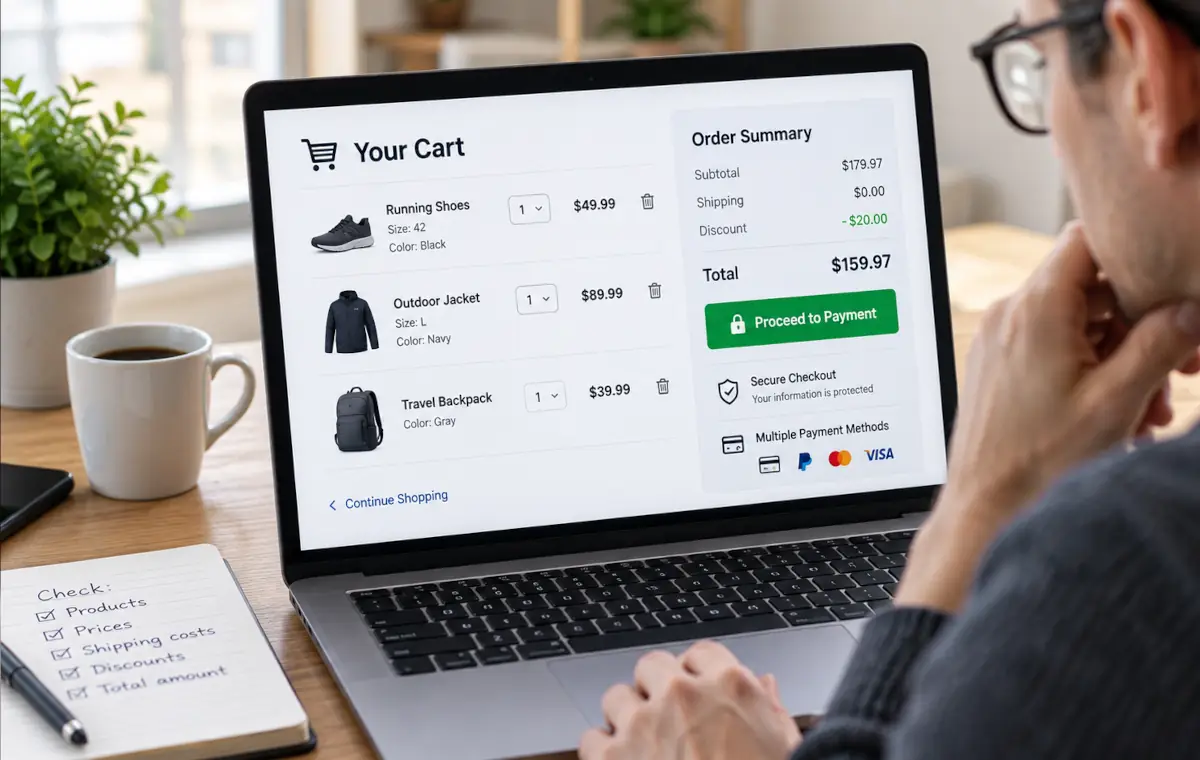 An online purchase deserves a pause just before payment. This step allows you to take back control of the journey, check the basket contents and reread the displayed conditions. Deceptive practices work better when the buyer lets themselves be guided by urgency or by the promise of a limited opportunity.
Identifying the seller is a first filter. The legal notices and terms and conditions must make it possible to understand who you are buying from, not only the trading name under which the shop presents itself. A company that is difficult to locate or presented as a mere front should lead to further checks.
Urgency messages should also be treated with caution. Phrases such as “Only 2 items left in stock” or “15 people are viewing this product” can be used to accelerate the decision, sometimes through automatically generated alerts. Even when stock is genuinely limited, the buyer benefits from checking whether the offer still makes sense without the pressure of a countdown.
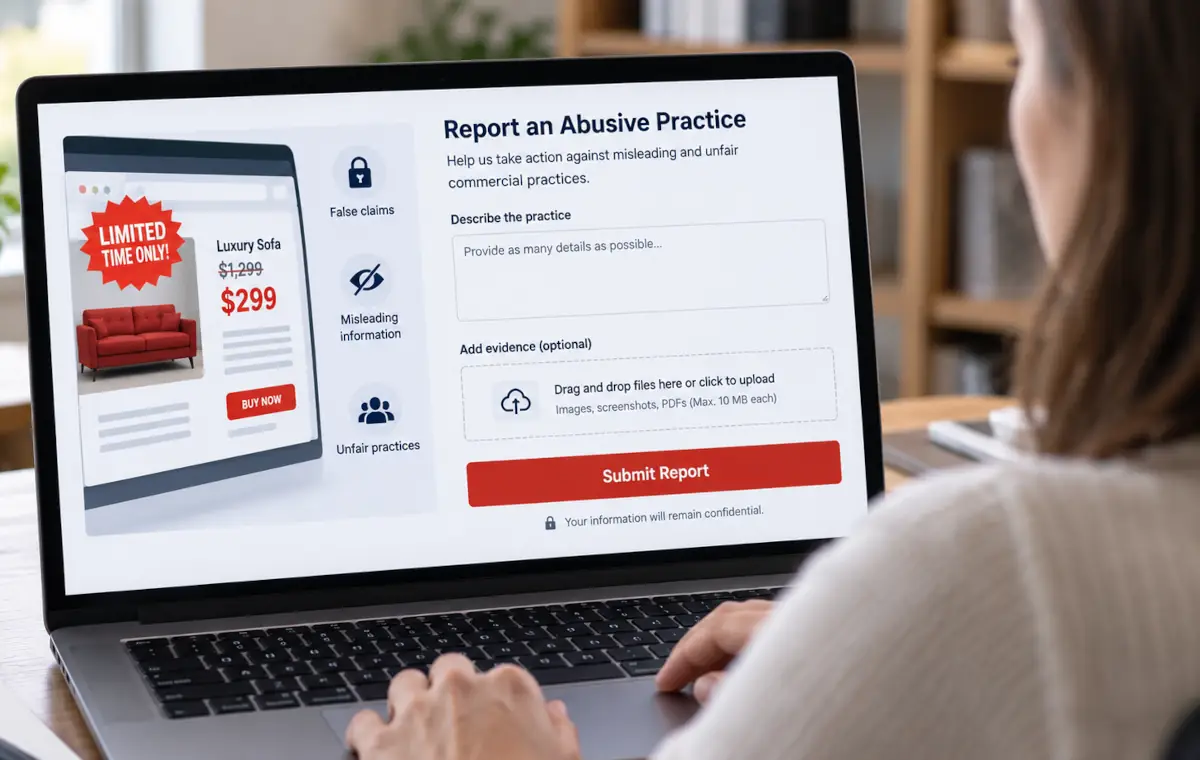 Regulators such as the Competition and Markets Authority in the UK or the Federal Trade Commission in the US monitor these infringements. This action does not exempt the buyer from staying vigilant, but it shows that deceptive practices are not just a simple commercial inconvenience. They can breach applicable rules when the information given to the consumer is false, incomplete or manipulative.
For a purchase made on a UK-based website, several basic protections should be kept in mind, including price transparency, the prohibition of misleading commercial practices and, in many distance-selling situations, a 14-day cancellation period. In the United States, protections vary more depending on the type of purchase and the state, but deceptive advertising, fake reviews, some hidden-fee practices and unfair or deceptive acts can fall within the scope of consumer protection enforcement.
In the event of an anomaly, keeping the visible elements at the time of purchase helps document the situation. Screenshots of the advertised price, final basket, displayed conditions, seller identity and exchanges with customer service may be useful. To report abusive behaviour, consumers can use official channels such as Citizens Advice or Trading Standards routes in the UK, and the Federal Trade Commission, a state attorney general or local consumer protection agency in the US.
Deceptive online commercial practices are progressing because they exploit the very habits of digital shopping: speed, trust in reviews, the appeal of discounts and automatic acceptance of basket steps. The best protection is to slow down at the right time, verify the seller, check the final price and keep evidence when the offer seems biased.
To strengthen your reflexes, you can consult our practical vigilance guide before buying, use the tool for analysing a dubious offer or deepen the right reflexes with our advice for understanding and reacting to fraud.