Blog post: Online security
Hello and welcome to Scam Or Reliable!

Blog post: Online security
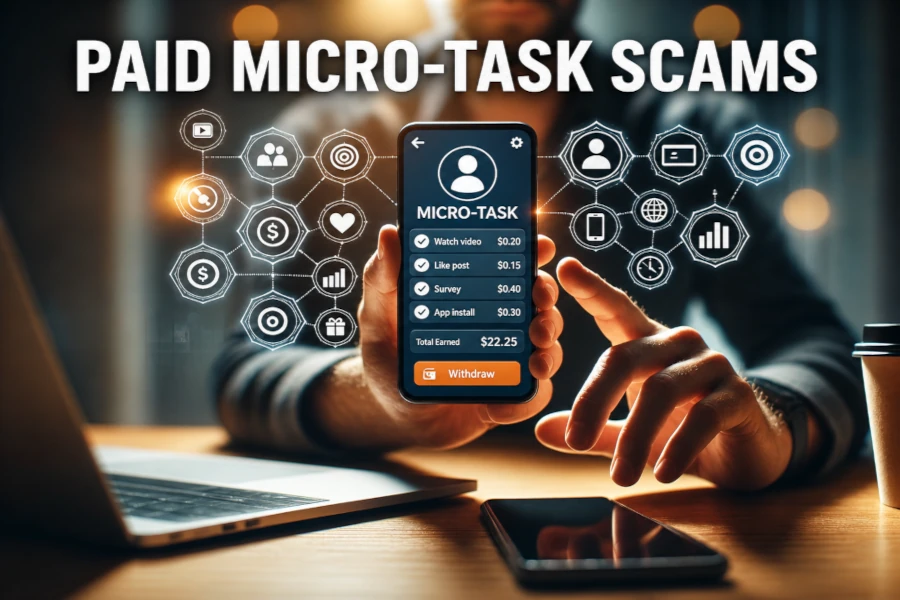 Paid micro-task scams promise that you can make money easily from your phone or computer. They present themselves as small, simple assignments: liking content, rating products, optimising listings, testing apps or validating fictitious orders. Behind this apparent simplicity, the scenario often aims to create the impression of progressive earnings before asking the victim to send their own money. This type of fraud sits at the crossroads of the fake job offer, the easy-income scam and financial fraud.
Fraudulent micro-tasks rarely arrive through traditional recruitment channels. The person usually receives an unsolicited message on WhatsApp, Telegram, SMS, email or social media, with a very simple proposal: make money by carrying out a few quick actions online. The offer stresses that no experience is required, that the work is flexible, that the earnings are immediate and that it can be done from home.
This approach is particularly effective because it resembles certain real forms of digital work. Genuine platforms for testing, surveys, moderation or small online tasks do exist. The difference is that, in the scam, the process quickly becomes opaque, artificial and centred on money deposits that the victim is asked to make.
The US consumer protection website FTC Consumer Advice (US) describes these frauds as “task scams”, sometimes gamified, in which victims see fake earnings appear on an app or platform. In the United Kingdom, the National Cyber Security Centre (UK) also warns about fraudulent approaches sent through messaging services, often using convincing scenarios and pressure tactics.
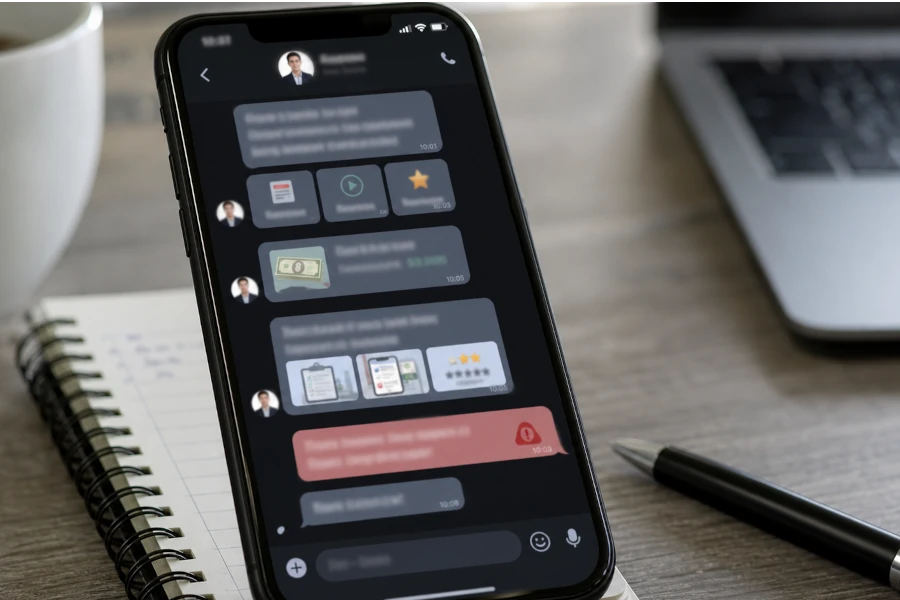 The mechanism relies on a gradual build-up of trust. At first, the person is invited to carry out a very simple task: click, like, rate, validate or simulate an order. The interface then shows a small gain, sometimes a few pounds or dollars, sometimes more, as if each action generated a real commission.
In some cases, fraudsters do actually pay a small amount at the start. This initial payment is not meant to reward real work, but to make the story look credible. The victim may then think that the platform genuinely works and that all they need to do is continue in order to earn more.
After a few steps, the situation changes. The platform announces that a higher level must be unlocked, that a batch of assignments must be completed, that an account must be reactivated, that a deposit or security payment must be made, that a balance must be topped up or that money must be deposited in order to withdraw the earnings. This is the core of the scam: the victim is no longer being paid to work, but is being pushed to pay in order to go on believing that they will be paid.
A micro-task offer is not necessarily fraudulent by nature, but some signs should be regarded as highly worrying. The first is unsolicited contact. A serious recruiter does not usually offer easy income to a stranger by private message, without an interview, without a clear contract and without any professional verification.
The second sign is the promise of disproportionate earnings. Very simple tasks, requiring no particular skill, cannot justify high and guaranteed pay. When an offer promises regular income for simple clicks, reviews or validations, you should ask who is really paying, why, and under what legal framework.
The third sign is a request for money. A genuine offer does not ask you to pay in order to receive a salary, unlock a commission, validate an account or access your own earnings. This rule is essential: when you have to pay in order to get paid, the risk of a scam is extremely high.
One of the most deceptive aspects of this fraud is the commitment effect. At the beginning, the victim mainly invests time. Then they see earnings displayed. Next, they pay a small amount to unlock the next step. At every stage, the idea of walking away becomes harder, because it would mean accepting that the time and money already invested are lost.
Fraudsters also exploit the logic of the blocked balance. For example, the victim sees a substantial amount on their dashboard, but cannot withdraw it. They are then told that one final payment, tax, validation or additional level will make it possible to recover everything. This promise of recovery keeps the trap going.
The danger is that the sums often increase in stages. After an initial payment, the platform may announce an error, a special assignment, a penalty or a new threshold that must be reached. The more the victim pays, the more the fraudsters adapt their script to stop them from breaking off contact.
 The sites used in these scams may look modern and structured. They sometimes display a dashboard, a balance, levels, commissions, task histories or assignment IDs. This staging creates an impression of professionalism, even though it proves nothing.
The vocabulary used is often deliberately vague. Fraudsters talk about optimisation, boosting, visibility, orders, ratings, digital marketing or algorithm improvement. These words give the system a technical appearance, but do not necessarily describe a real activity.
You should also be wary of the names of well-known companies or supposedly partner recruitment agencies. Identity impersonation is common in employment scams. The FTC Consumer Advice (US) explains that job scams are designed to steal money and personal information, while the National Cyber Security Centre (UK) warns against messages and sites that impersonate trusted organisations.
Before speaking with an unknown recruiter, you need to identify the company precisely, along with its official website, address, legal information and contact channels. A simple messaging page or a platform with no verifiable information is not enough. The absence of a clear contract, a defined professional status or precise payment terms should first be treated as a weak warning sign, and then potentially as a strong one if other elements are added.
It is also useful to search for the company name together with terms such as “scam”, “review”, “fake recruitment” or “task scam”. This search does not always prove that an offer is safe, but it may reveal useful testimonials or warnings. However, it is important to keep in mind that fraudsters regularly change names, domains or messaging accounts.
Finally, you should never install an unknown app simply because a recruiter asks you to. Some platforms may be used to collect information, push payments or trap the victim inside a controlled environment. A genuine working relationship must remain verifiable outside the interface provided by the contact.
If a micro-task platform asks you to send money in order to withdraw your earnings, you need to stop making payments. Even if a large balance appears on the screen, it may be entirely fictitious. Paying more does not guarantee a withdrawal; on the contrary, it signals to the fraudsters that the victim may still be manipulated.
It is advisable to keep the evidence: screenshots, phone numbers, email addresses, URLs, usernames, payment receipts, crypto wallet addresses and chat history. These elements may be useful for a report, a complaint or contact with the bank. It is best not to spend too long warning the fraudsters that steps are under way, because they may delete accounts or erase traces.
In the United Kingdom, a victim can consult the National Cyber Security Centre (UK), report certain frauds to Report Fraud (UK) depending on the case, or contact the police. In the United States, a victim can consult FTC Consumer Advice (US), report cyber-enabled fraud to the Internet Crime Complaint Center (IC3) (US) depending on the case, or contact law enforcement. If bank details have been shared or a transfer has been made, you must contact your bank without delay.
The best protection is to treat easy-income offers as proposals to be checked, never as opportunities to seize immediately. The more the message stresses simplicity, urgency and quick profit, the greater the caution should be. A real job can be attractive, but it does not rely on an upfront payment, an anonymous conversation and a promise of conditional withdrawal.
It is also important to separate uses. A dedicated email address for job applications, unique passwords, stronger authentication and particular caution with identity documents can help limit the consequences of fake recruitment. Fraudsters may be looking for money, but also for personal data that can be used in other scams.
Finally, you have to accept that an offer that is too vague often deserves to be ignored. Replying “just to see” may be enough to enter a persuasion process. Fraudsters know how to adapt their script to hesitation, financial difficulty and the need to find a quick solution.
Paid micro-task scams exploit a simple promise: making money easily with a few online actions. Their effectiveness comes from their gradual appearance, the small gains displayed, sometimes a first real payment, followed by a demand for money presented as a simple technical step. Yet the central rule remains clear: a serious job does not ask you to pay in order to access your wages.
Before replying to an offer that seems too easy, it is useful to review the essential reflexes for avoiding online traps. If you think you may already have been a victim, the support guide for scam victims can help you prioritise the steps to take. To practise spotting warning signs before clicking or paying, the interactive simulator of fraudulent situations can also be used as a prevention tool.