Blog post: Online security
Hello and welcome to Scam Or Reliable!

Blog post: Online security

 Scams involving online currency converters are multiplying with the digitalisation of payments and investments.
Behind interfaces that often look highly professional, these platforms use discreet mechanisms to divert money without immediately raising suspicion. Some manipulate exchange rates, others promise fictitious gains or block withdrawals.
Understanding these practices helps avoid financial losses that can sometimes be substantial and better secure your transactions.
Currency conversion tools are used every day, especially when travelling, shopping online or investing. Their frequent use and apparent simplicity make them an ideal target for scammers.
In addition, few users check the rates applied or the hidden fees. This implicit trust allows fraudsters to introduce discreet but significant discrepancies into conversions.
Finally, the rise of mobile apps and investment platforms has made it easier to create credible fake services, sometimes generated or optimised by artificial intelligence.
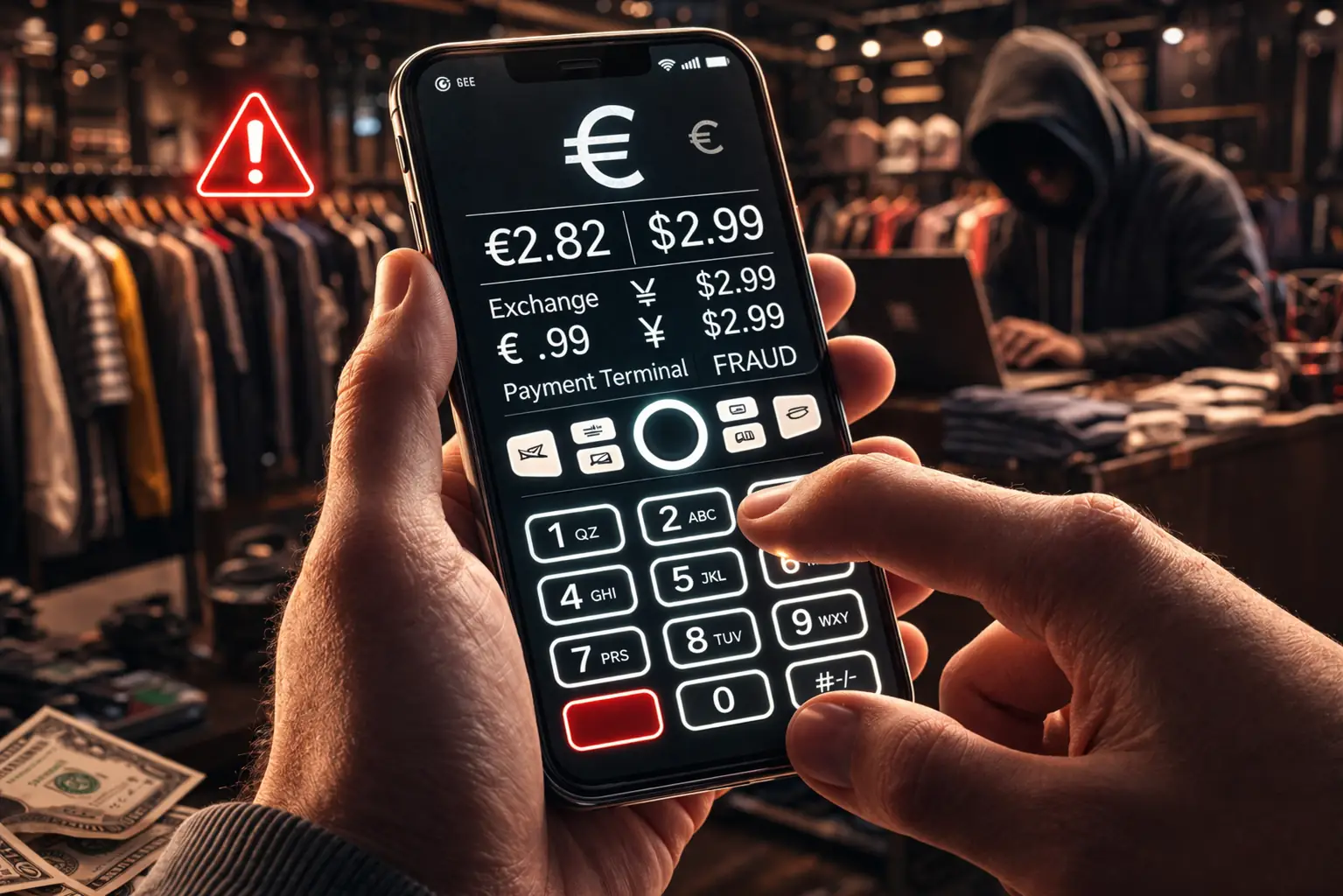
Dynamic Currency Conversion (DCC) is an option offered during payments abroad or on certain booking websites. It allows you to pay directly in your home currency instead of the local currency. This is a particularly current mechanism on in-store payment terminals, at hotels or restaurants, but also on ATMs abroad.
This option seems convenient because it immediately shows the amount in a familiar currency. However, it often hides an unfavourable exchange rate as well as additional fees that can amount to several percentage points. These fees are rarely stated clearly, which makes the scam difficult to detect.
Scams involving currency exchange also rely on phishing. Emails, text messages or adverts imitate a banking service, a travel company, a broker or a well-known converter. The link leads to a fake website where the victim enters their contact details, supporting documents or login credentials.
Some fraudsters do not just copy a design: they also use the identity of a regulated company or a financial authority to reassure the victim. This is particularly dangerous in the field of currency exchange and investing, where authorisation and trust play a decisive role.
The fake site can be used to steal banking data, but also to prepare a longer fraud. The victim is called back, guided, convinced, then pushed to make a transfer to an external account presented as a “currency account”, a “segregated account” or a “trading account”.
Another family of scams relies on fake currency converters or fake currency exchange apps. Some simply display biased estimates to make an offer look artificially attractive. Others go further by offering to receive or send funds directly.
The danger comes from the fact that the tool appears useful and harmless. A simple calculator can prepare the ground for a transfer to an unreliable platform. The user thinks they are comparing a rate, then ends up creating an account, sending documents, saving their card or initiating a transfer.
In the most serious cases, the funds disappear after the transfer, or the service then blocks withdrawals under the pretext of verification, technical fees, taxes or compliance requirements. This type of scenario is common as soon as an unknown operator promises abnormally favourable conditions.
The theme of currency exchange is often used to attract people trying to save money on international transfers or cross-border payments. Scammers promise an “unbeatable” rate, zero fees or an almost instant conversion. Once the victim is committed, they discover additional costs, artificial delays or a complete blocking of the transaction.
This fraud can happen through a mirror site imitating a known service, a sponsored advert, or a direct message on social media. The fake provider then pushes the victim to transfer the money to an account it controls, sometimes in the name of a company that appears legitimate.
The problem becomes worse when fraudsters impersonate a genuinely authorised operator. They reuse a company name, an authorisation number, a logo or an address to create an illusion of compliance.
The foreign exchange market, or Forex, is a classic breeding ground for scams. Fraudulent platforms promise quick gains, personalised support, trading robots, or high performance with supposedly controlled risk. These promises are already a warning sign.
The method is often gradual. The victim first deposits a modest amount, then sees fake gains appear on a dashboard. A very insistent contact then encourages them to invest more to “unlock” a higher level, benefit from leverage or seize a “market window”.
In many cases, the money is never actually invested. The dashboard is only a staged illusion. The fake adviser may also ask for remote access to the computer or phone, which opens the door to further misuse.
One often overlooked point concerns victims who have already been trapped once. After a loss linked to a fake broker or a fake currency exchange service, they may be contacted again by supposed fund recovery specialists. These are the so-called “recovery room” scams.
The pitch is well rehearsed: a fake expert, a fake government body or a fake firm explains that it has traced the lost sums. All that is required, it claims, is the payment of taxes, file fees, conversion fees or a guarantee before the funds can be returned.
This second fraud is particularly insidious because it exploits the desire to recover what has already been lost. A serious financial authority will not ask you to pay in order to miraculously release missing funds.
Adopting a few simple reflexes can greatly reduce the risks linked to these scams:
It is also recommended to consult official bodies such as the FCA (UK) and its warnings, as well as the National Cyber Security Centre (UK) and the official portal GOV.UK (UK) in the United Kingdom, and the CFTC (US), the FTC (US) and the official portal USA.gov (US) in the United States.
Scams involving currency converters rely on discreet but effective mechanisms, exploiting a lack of vigilance regarding rates and fees. Their growing sophistication makes them harder to detect, especially with the use of advanced technologies.
By staying alert and adopting simple practices, it is possible to reduce the risks considerably. To explore these reflexes further, read our guide on the essential strategies for protecting yourself against fraud as well as our guide on best practices for keeping your online activities secure.
To support you, we also provide the following tools:



Scam Or Reliable: The free and independent reference dedicated to anti-fraud information, the analysis of deceptive practices and the protection of consumers against online risks. Our team publishes articles, alerts and educational content to help internet users spot signs of scams, understand fraud mechanisms and adopt the right reflexes when faced with digital scams.
Its goal: to contribute to the prevention of scams, phishing, fake websites, impersonation and online commercial manipulation by providing clear, rigorous and useful content based on the analysis of verifiable signals, testimonies and reliable sources.
Warnings: The information presented on this blog is provided for informational and preventive purposes only. It does not constitute official recommendations or personalised legal, financial or technical advice. It must be verified with the relevant organisations, services or contacts depending on the situation. We are not responsible for errors, omissions or inappropriate use of the information provided on this site. If you notice any inaccuracy, please let us know.